
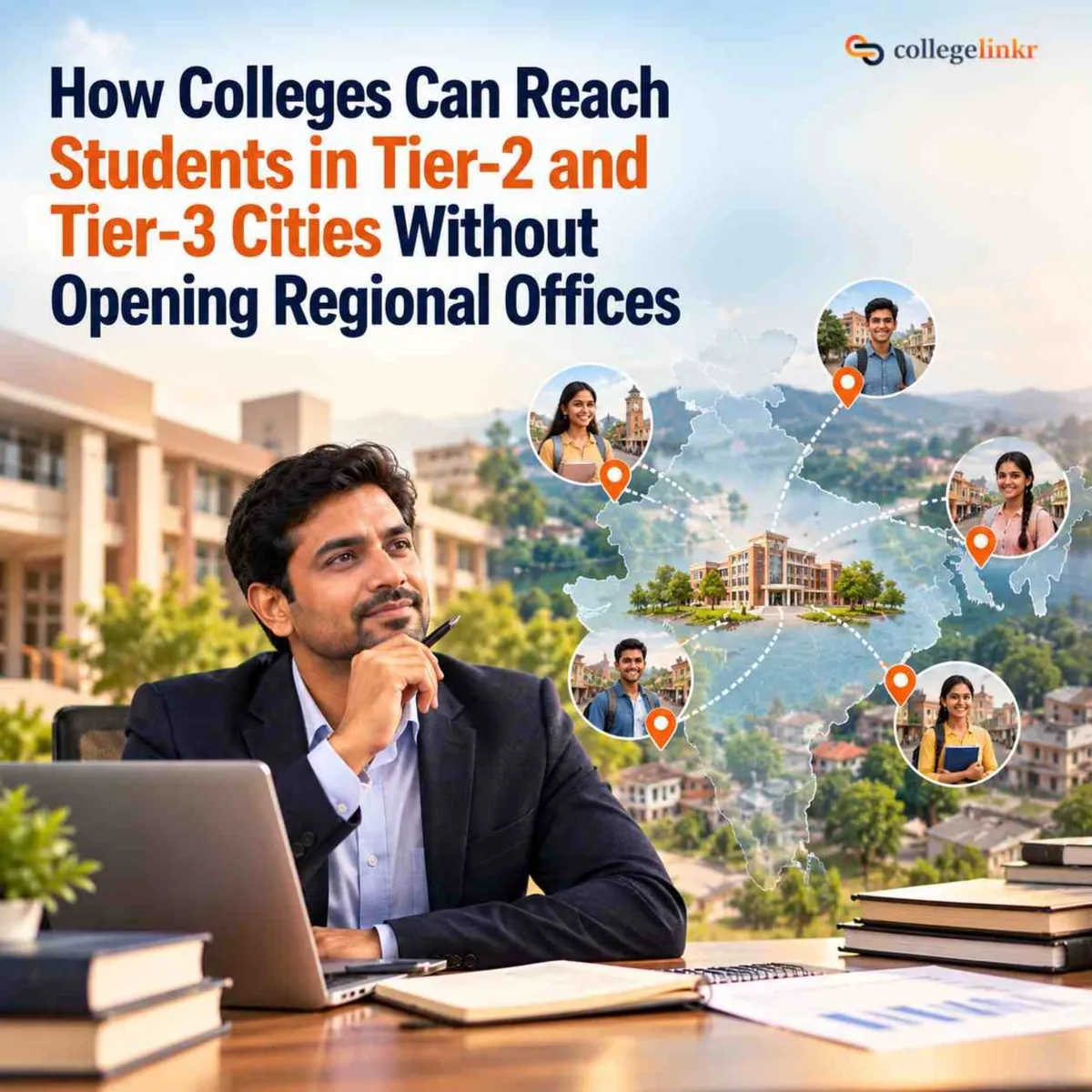
How Colleges Can Reach Students in Tier-2 and Tier-3 Cities Without Opening Regional Offices

The next big wave of college applicants is coming from smaller towns, not just metros. But regional offices, roadshows and local agents are costly and hard to manage. This guide explains what students in Tier-2 and Tier-3 cities need from a college, and how an…
The Students You Are Not Reaching Yet
Ask most admission teams where their applicants come from and the answer is predictable. The home city, a few nearby districts, and perhaps one or two metros where the college has run campaigns. Everything else is a blur.
That blur is where much of India's new demand is coming from. Ministry of Education data from the All India Survey on Higher Education (AISHE), released in July 2026, shows that the Gross Enrolment Ratio in higher education climbed to 30 in 2023-24 from 23.7 in 2014-15. Female GER has gone up to 31.2, and the GER for Scheduled Caste students rose from 18.9 to 27.8 over the same decade. For Scheduled Tribe students it rose from 13.5 to 22.8.
Those numbers describe millions of first-time college-goers, many of them from district towns and smaller cities. They are ambitious, often willing to travel for the right programme, and frequently overlooked by colleges that market only where they already have a name.
Also Read
- How Colleges Can Reduce Marketing Costs with Pay-on-Admission Model?
- Beyond Lead Generation: How Colleges Can Get Application-Ready Students Through an Admission Network
- 8 Higher Education Marketing Strategies to Boost Student Enrollment in 2026
- Building a Referral-Based Admission Growth Engine for Colleges
Why Smaller-City Students Are Worth Your Attention
There is a practical case here, not just a social one.
They are willing to move for the right course
A student in Bhagalpur, Sangli or Tirunelveli may not have the programme they want close to home. Many families accept that their child will study in another city or state if the course, safety and cost make sense.
Competition for their attention is lower
Big brands spend heavily in metros. In smaller cities, a college that shows up with clear information and a trusted local guide often faces far less noise.
They tend to stay committed once they join
Families in smaller towns usually make admission decisions carefully and as a household. Once they choose, they tend to stick with that choice, which helps retention.
Financing is becoming easier
The PM-Vidyalaxmi scheme, approved by the Union Cabinet in November 2024, offers collateral-free and guarantor-free education loans to students who get admission into eligible quality higher education institutions. The scheme also offers 3% interest subvention on loans up to ₹10 lakh for students with annual family income up to ₹8 lakh. For many families outside metros, a lower barrier to funding makes an out-of-town college realistic.
Why the Traditional Approach Struggles
Colleges that try to reach smaller cities usually reach for one of three tools. Each has real limits.
Regional offices
An office in another state means rent, staff, travel and supervision. It also covers only one city. A college that wants to reach ten states would need ten offices, each running at full cost even in months when no one is applying.
Roadshows and education fairs
Fairs bring footfall for a day or two, but they are expensive to attend, crowded with competitors and difficult to follow up on. Many enquiries collected at a fair go cold within weeks.
Unstructured local agents
Some colleges work with individual agents in different towns. This can work, but it is hard to verify who the agents are, how they describe your programmes and whether students are getting honest advice. Commission terms vary from person to person, and there is little visibility into what happens between the first conversation and the final admission.
What Students in Smaller Cities Actually Need
Before choosing a channel, it helps to understand what these families are looking for. In most cases, it comes down to five things.
Someone they can talk to locally
Many parents will not commit to a college on the basis of a website alone. They want a person they can meet, call, or ask questions in their own language.
Clear proof that the college is genuine
Recognition, approvals and affiliation matter a great deal. Families who have heard stories about unrecognised institutions will want reassurance before paying any fee.
Help with documents and forms
Students who are the first in their family to go to college may not know which certificates are needed or how to get them. Platforms such as DigiLocker, run by the Ministry of Electronics and IT, have made digital marksheets and certificates easier to share, but someone still needs to guide families through the steps.
Honest information about total cost
Tuition is only part of the picture. Hostel, mess, travel and exam fees add up. Families want the full number upfront so they can plan or apply for scholarships and loans.
A sense of what happens after admission
Students moving to a new city worry about accommodation, safety, language and whether they will fit in. A college that explains these clearly removes a major source of hesitation.
How an Admission Network Solves the Distance Problem
An admission network brings together education consultants spread across many cities and connects them to verified colleges through one platform. Instead of your college building a presence town by town, you tap into people who are already there and already advising students.
Local trust, without local overheads
Consultants in the network live and work in the communities they serve. Parents already know them. When a consultant recommends your programme, that recommendation carries weight you could not buy with an advertisement.
Standardised information about your college
Because your course details, eligibility criteria and fee structure sit on one platform, every consultant shares the same accurate information. You avoid the mixed messages that come from scattered agents.
Applications that arrive complete
The consultant checks eligibility, collects documents and submits the application. By the time it reaches your desk, it is ready for review rather than a phone number you still need to chase.
Costs that follow results
The best networks charge only when a student actually takes admission. That means reaching a new state costs you nothing until it produces a real student.
How CollegeLinkr Helps Colleges Reach Students Across India
CollegeLinkr connects colleges with a PAN-India network of more than 10,000 education consultants, called Members, who guide students through course selection and admission.
- Your college is listed for free, with no marketing spend or listing charge.
- Members across the country see your courses, eligibility criteria and fee details in one place.
- Members counsel students, verify eligibility, collect documents and submit applications for you.
- You review applications on a single dashboard and confirm admissions.
- You pay only when an admission is confirmed, at a commission you set for each course.
For a college in Bengaluru, Pune or Bhopal, this means a student in a district town hundreds of kilometres away can discover your programme, get guidance from someone they trust and apply with complete paperwork, without you opening a single office.
Practical Tips for Winning Smaller-City Students
Getting visibility is the first step. Converting interest into confirmed admissions takes a little more care.
- Publish a full fee breakdown, including hostel, mess and exam charges, so consultants can share an honest total.
- List scholarships you offer and help students apply for government schemes through the National Scholarship Portal.
- Share clear details about hostel facilities, safety measures and support for students from other states.
- Prepare a short note on how students travel to your campus from major railway stations and airports.
- Offer a regional language contact or helpline where possible, even if teaching is in English.
- Respond to every application within a fixed time, ideally 48 hours, so families do not lose confidence.
- Keep your course and eligibility information on the network updated, especially when deadlines change.
Final Thoughts
India's growth in higher education is not happening only in its biggest cities. It is happening in district towns, in families sending their first child to college, and in regions where many good institutions have never had a presence.
Colleges that reach these students early will build stronger, more diverse batches for years. The good news is that doing so no longer requires an office in every state. With a trusted network of consultants and a pay-on-admission model, a college can extend its reach across India while keeping costs firmly tied to results.
Resources
- Union Ministry of Education releases AISHE 2022-23 and 2023-24 reports (Press Information Bureau)
- Cabinet approves PM-Vidyalaxmi scheme (Ministry of Education)
- National Scholarship Portal (Government of India)
- DigiLocker (Ministry of Electronics and Information Technology)
Do you guide students in your town towards the right college? Download the CollegeLinkr App to access verified colleges across India, submit applications and track every student's admission from your phone.
Frequently Asked Questions
Grow Your Admissions With CollegeLinkr
Every seat left empty is revenue your campus never sees.
Become a partner college and fill more seats — with less effort.
Free to list · No marketing spend · Pay only on confirmed admission