
Building a Referral-Based Admission Growth Engine for Colleges

Every admission team feels it: acquisition costs keep climbing faster than budgets. Yet the channel students trust most — referrals from current students, alumni, and parents — costs the least. This guide breaks down the five parts of a real referral engine: a…
Every admission team knows the feeling: the marketing budget goes up every year, but the cost of putting one student in a seat keeps climbing faster than the budget does. According to EAB and ScaleGrowth Digital benchmarks, the average cost to acquire one enrolled undergraduate student now stands at roughly $1,505 (approximately ₹1.44 lakh), while graduate acquisition runs closer to $3,804 (approximately ₹3.65 lakh) per student — figures that reflect the full funnel from first click to confirmed enrolment, not just ad spend. Ruffalo Noel Levitz's institutional cost-of-recruitment data shows an even starker divide: private four-year institutions spend an average of $2,795 (approximately ₹2.68 lakh) to recruit a single undergraduate, compared to roughly $494 (approximately ₹47,400) at public institutions — a five-to-six-times gap driven almost entirely by paid advertising and third-party lead generation.
At the same time, the channel that costs colleges the least is the one prospective students trust the most. That channel is referral — a recommendation from a current student, an alumnus, a parent, or a friend who has already lived the experience the college is trying to sell.
This is not a soft, "nice to have" marketing idea. It is a measurable, budget-relieving growth channel, and the data behind it — from consumer psychology research to higher-education-specific studies — makes a compelling case for building it deliberately rather than hoping it happens on its own.
The Trust Gap: Why Referrals Outperform Paid Advertising?
Nielsen's long-running Global Trust in Advertising study, which has surveyed tens of thousands of consumers across dozens of countries, has consistently found that recommendations from people we know are the single most trusted form of advertising — cited by roughly 83–92% of respondents across different survey years, well ahead of trust in television, print, or online display ads. The same research shows consumers are significantly more likely to act on a product or service recommendation when it comes from a friend or family member rather than a brand.
This isn't unique to consumer goods. Academic research into higher education specifically confirms the same pattern:
- A 2025 study published in Humanities and Social Sciences Communications (Nature portfolio) surveying 816 first-year university students found that student satisfaction directly drives positive word-of-mouth toward prospective students, and that this effect is amplified when perceived education quality is high — meaning a genuinely good student experience compounds into more organic advocacy.
- Research on electronic word-of-mouth (eWOM) in university selection has found that friends are a strong source of recommendation, but family plays the dominant role in the final decision — a finding especially relevant in markets like India, where parents are deeply involved in college selection.
- A study published in the Journal of Business Administration Online on first-encountered touchpoints in higher education found that early admissions interactions shape the word-of-mouth an institution receives for years afterward, making the admissions office itself — not just the classroom — a driver of referral quality.
The takeaway for admission teams: referral isn't a separate marketing tactic bolted onto recruitment. It is a downstream effect of the actual student experience, amplified or dampened by how the admissions process treats people.
The Business Case: What a Formal Referral Program Actually Delivers?
It's one thing to say "referrals are trusted." It's another to show they move the enrollment needle in ways a CFO would approve. Cross-industry referral marketing data — most of it validated in peer-reviewed marketing research — is unusually consistent:
| Metric | Data Point | Source |
|---|---|---|
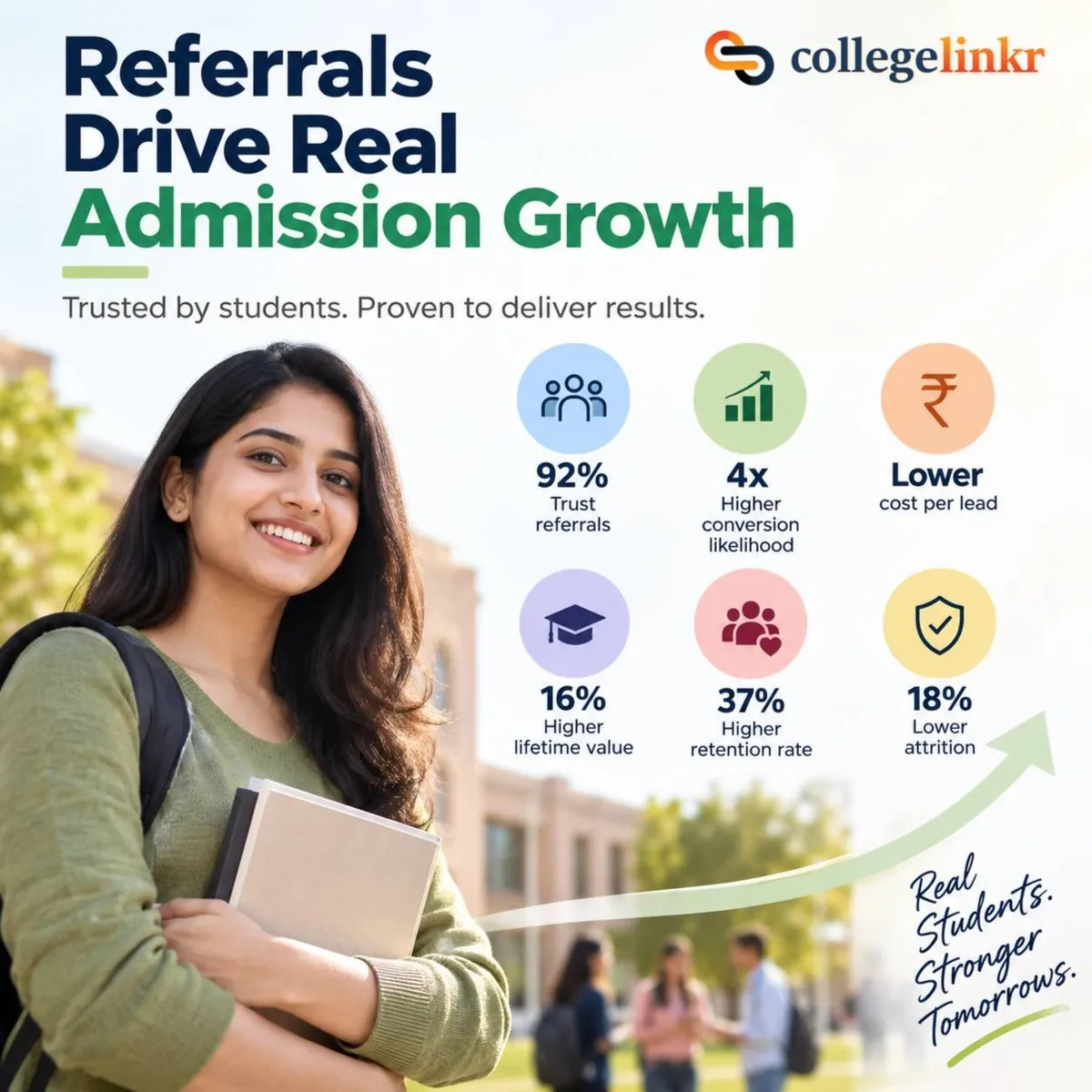
| Trust in referrals vs. all other advertising | 92% of consumers trust recommendations from people they know | Nielsen, Global Trust in Advertising |
| Likelihood to convert when referred | Referred customers are about 4x more likely to convert | Referral marketing research (multiple studies) |
| Lifetime value of a referred customer | 16% higher than a non-referred customer with similar demographics | Journal of Marketing / Wharton School |
| Churn / attrition of referred customers | 18% lower churn rate | Wharton School research |
| Retention rate of referred customers | 37% higher than customers acquired via other channels | Deloitte |
| Reduction in cost per lead | Formal referral programs report lower cost-per-lead than paid channels | Referral Rock / Extole benchmarking |
Translated into admissions language: a student who enrols because a current student, alumnus, or satisfied parent told them to enrol is statistically more likely to actually show up in the fall, more likely to persist to graduation, and cost the institution a fraction of what a cold, paid-search-generated lead costs to convert.
This is exactly the kind of leverage colleges need given what the funnel already costs. If digital advertising alone generates a lead for roughly $140 (approximately ₹13,400) (Search Influence, 2025 benchmarking) before that lead is even qualified, nurtured, and converted, a referral that arrives pre-qualified by trust is worth protecting and scaling — not leaving to chance.
Proof from Real Campuses
Referral and peer-advocacy programs aren't theoretical in higher education — several institutions have published measurable outcomes:
- University of Adelaide implemented a structured peer-to-peer ambassador program connecting offer-holders with current student ambassadors for ongoing 1:1 conversations. The result was a 66% offer-acceptance rate among prospective students who engaged with an ambassador, along with expansion of the program from international recruitment into domestic recruitment because of its success.
- Case Western Reserve University's School of Engineering built its ambassador program by recruiting from existing student leadership groups and then layering in a referral system — ambassadors recommending other strong candidates for the ambassador role itself, with incentives tied to retention. In one recruitment cycle, the university saw a 154% increase in applications over its own intent-signal projections.
- Research from Intead, a U.S. higher-education marketing firm, analysing more than 370,000 online admissions conversations, found that 57% of prospective students said input from a student ambassador was the most helpful part of their admissions process — ahead of brochures, webinars, and even campus tours in some segments.
None of these results came from a generic "refer a friend" banner on a website. They came from admissions teams treating referral as infrastructure: recruiting the right advocates, training them, giving them tools, and tracking outcomes with the same rigor applied to paid campaigns.
Also Read
Anatomy of a Referral-Based Admission Growth Engine
A referral engine has five interlocking parts. Miss any one of them and the "engine" becomes a one-off campaign instead of a repeatable growth channel.
1. Identify Your Advocate Pools
Not every referral source behaves the same way, so each needs its own approach:
- Current students — the most credible voice for "what is it actually like here," best activated through structured ambassador programs rather than ad-hoc requests.
- Alumni — carry long-term credibility and are especially persuasive with parents and working professionals evaluating career outcomes; research consistently shows institutions with active, ongoing alumni engagement see stronger referral-driven enrolment.
- Parents of enrolled students — particularly influential in markets where family plays a central role in the final decision, as the eWOM research on university selection confirms.
- Faculty and department heads — under-used in most referral strategies, but powerful for niche or professional programs where a mentor's endorsement carries subject-matter authority.
- School counsellors and coaching centres — a B2B-style referral relationship that functions differently from peer-to-peer referral but is equally systematic and trackable.
2. Design Incentives That Reward the Right Behaviour
The biggest gap in most referral programs isn't willingness — research shows roughly 83% of satisfied customers across industries say they are willing to refer, but only around 29% actually follow through. That gap is closed with structure, not persuasion. Effective designs typically include:
- Dual-sided rewards — something of value for both the referrer and the referred student (a fee waiver, a scholarship credit, priority housing, or a small stipend), which industry data shows generates meaningfully more referrals than one-sided incentive structures.
- Milestone-based payouts rather than lump sums at the point of application — for example, a portion of the reward released at application, and the remainder only after the referred student is confirmed and has completed a full term. This protects against low-quality or fraudulent referrals and mirrors how Case Western structured its own ambassador referral incentives around semester-long retention.
- Non-monetary recognition — leaderboard visibility, certificates, letters of recommendation credit, or "Ambassador of the Month" status, which cost the institution very little but matter significantly to student and alumni advocates motivated by status and belonging rather than cash.
3. Build the Technology Layer
A referral program without tracking infrastructure is just a suggestion. At minimum, the engine needs:
- Unique referral codes or links for every advocate, tied into the admissions CRM (Slate, Salesforce Education Cloud, TargetX, or equivalent) so every enquiry can be attributed to its true source.
- A simple submission portal — a form, WhatsApp bot, or app — where advocates can submit a referral in under a minute; friction at this stage is the single biggest reason otherwise-willing advocates never refer anyone.
- Automated status updates back to the referrer (application received, interview scheduled, offer made, enrolled) so advocates stay engaged through the full cycle instead of referring once and disengaging.
- Dashboard-level reporting for the admissions team showing referral volume, conversion rate by advocate type, cost per referred enrolment, and comparison against paid-channel CAC — the same KPIs used elsewhere in the funnel, applied consistently here.
4. Train Advocates Like You Would Train Staff
The institutions seeing the strongest results — Adelaide and Case Western among them — invest real time in preparing ambassadors: structured onboarding sessions, guidance on what they can and cannot promise, practice conversations, and clear escalation paths for questions they can't answer. An untrained advocate risks giving inaccurate information about fees, deadlines, or scholarships, which damages trust rather than building it. A 20–30 minute structured session covering do's, don'ts, and FAQs is a low-cost, high-return investment.
5. Measure It Like Any Other Channel
Every referral programme should be judged on the same unit economics as paid marketing:
Referral Cost per Enrolment = (Total incentive payouts + program admin cost) ÷ Number of confirmed enrolments from referral
Compare this figure directly against your blended digital CAC. Given that EAB/ScaleGrowth benchmarks place blended undergraduate CAC around $1,505 (~₹1.44 lakh) and RNL places private-institution CAC closer to $2,795 (~₹2.68 lakh), most well-run referral programs — where incentives are modest and milestone-gated — land well below both figures, often alongside the higher retention and lower churn that referred students already bring to the table.
Guardrails: Doing This Ethically and Compliantly
Referral programs in admissions sit close to a line that institutions must respect. A few non-negotiables:
- Never pay a referrer contingent solely on a specific student's enrolment decision in a way that resembles commission-based recruiting of individual applicants — most accreditation bodies and national admissions counselling associations discourage per-enrolment "bounty" structures that could be seen as incentivizing misrepresentation. Reward structures should be modest, transparent, and disclosed.
- Disclose the relationship. If a current student or alumnus is being compensated for referrals, that should be clear to the prospective student, consistent with basic marketing transparency norms.
- Protect data privacy. Referral forms collect personal information about prospective students who haven't yet consented to being contacted by the institution directly — data handling here should follow the same consent standards as any other lead-capture channel.
- Audit for quality, not just volume. Track not only how many students a referral program brings in, but how they perform academically and how long they persist — the entire value proposition of referral rests on bringing in better-fit students, and that has to be verified, not assumed.
- Check this against UGC/AICTE rules before designing incentives (India-specific). Indian regulators take a harder line on commission-based recruitment than the general international norms cited above: the UGC's anti-capitation-fee rules and AICTE's regulations on admission practices restrict paying individuals for bringing in specific students, and this is enforced particularly strictly for professional programmes (medical, engineering, management) overseen by bodies like the NMC. A "dual-sided reward" or "milestone-based payout" that would be routine in the US may need legal review before it is workable at an Indian institution — favour non-monetary recognition and institution-level (not individual-level) incentives where compliance is uncertain. Data handling should also be checked against India's Digital Personal Data Protection (DPDP) Act, 2023, rather than assumed to be covered by generic "consent standards."
A 90-Day Rollout Framework
For colleges building this from scratch, a phased rollout keeps the program manageable:
- Weeks 1–2: Foundation. Define advocate pools, set incentive structure, get sign-off on budget and compliance guardrails.
- Weeks 3–4: Technology setup. Stand up referral tracking (even a simple CRM campaign source field and unique link generator is enough to start), build the submission form.
- Weeks 5–6: Recruit and train the first cohort of advocates. Start small — 15 to 25 current students or recent alumni — rather than opening it to everyone at once.
- Weeks 7–10: Soft launch. Run the program with the initial cohort, monitor referral quality and advocate engagement weekly, fix friction points in the submission and follow-up process.
- Weeks 11–13: Full launch and reporting cadence. Expand the advocate pool, publish the first cost-per-referral-enrolment report against paid-channel CAC, and set a recurring monthly review with the admissions leadership team.
Frequently Asked Questions
The Bottom Line
Paid acquisition will always be part of the admissions marketing mix, but it is a channel with diminishing, increasingly expensive returns. Referral is the opposite: a channel that gets cheaper and more effective the more deliberately it's built, because it runs on something advertising can't buy — trust that already exists between the people telling the story and the people deciding whether to believe it.
The colleges winning the enrolment race over the next few admission cycles won't just be the ones spending more on ads. They'll be the ones that turned their own students, alumni, and parents into a structured, trained, and measured growth engine.
Grow Your Admissions With CollegeLinkr
Every seat left empty is revenue your campus never sees.
Become a partner college and fill more seats — with less effort.
Free to list · No marketing spend · Pay only on confirmed admission