
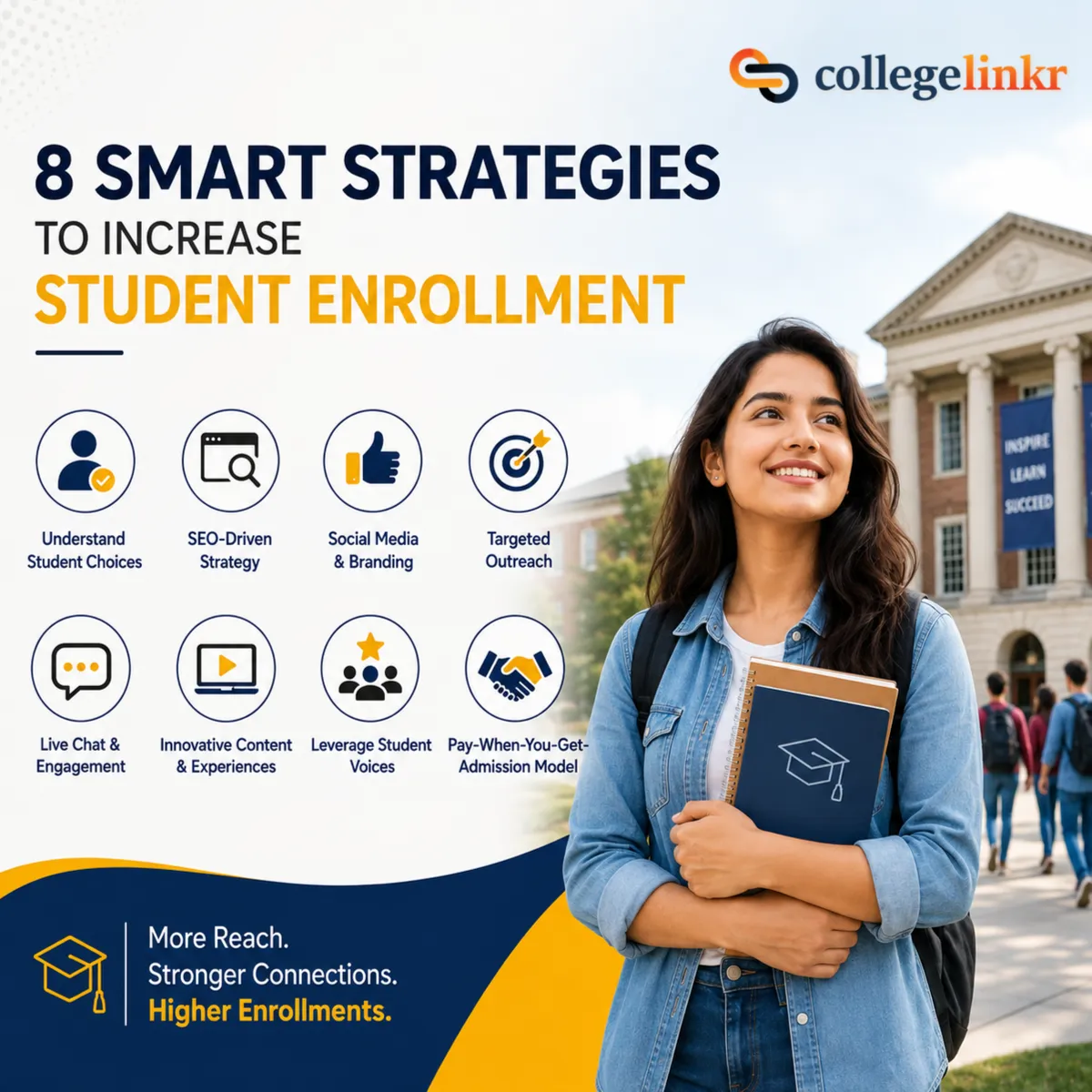
8 Higher Education Marketing Strategies to Boost Student Enrollment in 2026

Prospective students now research colleges digitally before making contact. They Google courses, check placements, browse social media, read reviews, and compare fees across institutions. With search engines often serving as the first touchpoint, colleges need…
Ask any admissions director how the job has changed over the last few years, and you'll hear some version of the same story: students don't wait for a prospectus to land in their inbox anymore. They Google the course, check placement records on LinkedIn, scroll through a college's Instagram reels, read a few forum threads, and only then decide whether a campus visit is worth the trip. Recent higher education marketing research puts a number on this shift — well over three-quarters of prospective students now use a search engine as their first touchpoint with a college, and a large majority compare tuition, placements, and reviews across several institutions before submitting a single inquiry form.
For colleges and universities, that changes what “marketing” even means. It's no longer a prospectus, a few newspaper ads and a stall at an education fair. Student enrollment marketing today has to work across search results, social feeds, WhatsApp chats, parent conversations and word-of-mouth from current students — all at once, and all pointing toward the same admission funnel.
The eight strategies below aren't theoretical. They're the approaches admissions and marketing teams are actually using right now to fill seats — from search visibility to performance-based partnerships that only cost money once a student actually enrols.
1. Start With Why Students Choose — Not What You Want to Say
Picking a college is one of the biggest decisions a family makes, and it rarely comes down to a single factor. Placement records, faculty reputation, fee structure, campus life, location, and even how quickly the admissions office replies to a query — all of it gets weighed, often by the student and their parents together.
Yet a lot of college marketing still leads with what the institution wants to say rather than what the student wants to know. A brochure that opens with the college's founding year and its sprawling green campus tells a prospective engineering student very little about their actual placement odds.
Flip the order. Lead with outcomes — average package, top recruiters, internship tie-ups, faculty who've actually worked in the industry, alumni now running their own companies. Let the campus and heritage support that story rather than replace it.
Personalisation matters just as much as the message itself. A student weighing engineering options is looking for something completely different from someone comparing MBA programs or nursing courses. Bundling them into the same generic newsletter is a missed opportunity — segment your communication the moment you know what a student is actually interested in.
2. Build an SEO Strategy That Matches How Students Actually Search
By the time a student types anything into Google about your college, they've usually already decided they're at least somewhat interested. That's exactly why search engine optimisation has become one of the highest-return channels in higher education marketing — it meets students at the moment they're actively looking, not while they're scrolling past an ad.
The mistake most college websites make is optimising only for the big, obvious keywords — “MBA colleges,” “engineering colleges,” “BCA admission.” Those terms are also the most competitive, and a newer or mid-sized institution rarely breaks onto page one for them.
Long-tail, intent-rich searches are where the real opportunity sits. A phrase like “MBA colleges in Bangalore with 100% placement” or “affordable BCA colleges near me with hostel facility” carries far less competition — and far higher intent — than a generic head term. Building dedicated pages around specific programs, eligibility criteria, fee structures, scholarships, placement statistics and career outcomes gives Google, and students, exactly what they're searching for.
Local SEO shouldn't be an afterthought either. An accurate, regularly updated Google Business Profile, location-specific landing pages and city-wise keyword targeting can be the difference between showing up for “colleges near me” searches and not showing up at all.
SEO isn't a campaign you switch on before the admissions season and off afterwards. It compounds. The pages you build this year keep bringing in high-intent applicants next year and the year after, usually at a fraction of the cost of paid ads.
3. Treat Social Media as a Brand, Not a Notice Board
A lot of institutional social media still reads like a digital notice board — admissions open, last date to apply, fee due reminder. None of that tells a 17-year-old scrolling Instagram what it actually feels like to study there.
Platforms like Instagram, YouTube, LinkedIn and Facebook are where prospective students form their first real impression of campus culture, often long before they read the “about us” page. Fest highlights, a professor explaining a tricky concept in sixty seconds, a placement success story, a candid “day in the life” reel — this is the content that actually gets watched, shared and remembered.
Consistency in visual identity and tone builds recall faster than any single viral post. And student ambassadors are often more persuasive than any official college account will ever be — prospective students trust a current student's honest take on hostel food and faculty far more than a polished admissions video.
4. Stop Running One Campaign for Everyone
Sending the same message to every lead in your database might look efficient on a dashboard, but it rarely converts well. A student who has already shortlisted your B.Tech program is at a completely different decision stage than someone still comparing three or four career paths — and each needs different information at a different moment.
Segment leads by course interest, location, academic background and how far along they are in the admission journey. Then follow up with purpose: scholarship details for a price-sensitive lead, placement data for a career-focused one, hostel and campus-life content for someone moving cities for the first time.
Persistence pays off here too. Most students inquire with several colleges before deciding, and the institution that stays visible with timely, relevant follow-ups — not just repeated “apply now” reminders — tends to win the eventual decision. Don't leave parents out of this loop either, especially for undergraduate admissions, where they're often the ones asking the harder financial and safety questions.
5. Give Students a Real Person to Talk To
No matter how detailed a website is, students will always have questions a static page can't answer well enough. What's the actual take-home fee after scholarships? Is the hostel co-ed? Which companies visited last year specifically for this branch? When exactly does the application window close?
A live chat widget, a responsive WhatsApp line, or a counsellor who actually picks up the phone can turn hesitation into an application. These conversations are also a goldmine of insight — the questions that come up again and again should be feeding straight back into your FAQ pages, your ad copy and your next campaign.
The real value of direct engagement isn't just answering questions. It's catching a student at the exact moment their interest could tip into an application — or quietly slip away to a competitor who replied faster.
6. Go Beyond the Brochure
Static admission ads and PDF brochures still have a place, but they're no longer where prospective students spend their attention. Short-form video, virtual campus tours, student-hosted podcasts, live webinars with faculty, and interactive admission quizzes let students experience a campus before they've ever set foot on it.
Video, in particular, does something a photo gallery can't — it lets a prospective student picture themselves in the classroom, the lab, the hostel corridor. And because most of this research happens on a phone, every landing page, application form and chatbot needs to work just as well on a small screen as it does on a laptop.
The goal isn't to chase every new platform the moment it trends. It's to figure out where your specific prospective students are already spending time, and show up there with something genuinely useful — not just another ad.
7. Let Current Students Do the Talking
Prospective students are naturally skeptical of anything that sounds like marketing — and rightly so. What they trust instead is unscripted, first-person content from people actually living the experience: classroom videos, “day in my life” reels, honest reviews of hostel food, project showcases, placement journeys told in a student's own words.
This is where user-generated content earns its place in a college marketing strategy. Give student ambassadors loose themes to work with — a fest, a placement drive, a lab session — and let them tell it their own way instead of handing them a script. The rougher, more authentic version usually outperforms the polished one, precisely because it doesn't feel like an advertisement.
Authentic student voices don't just generate views. They move a hesitant prospect from “researching colleges” to “seriously considering this one” — a shift no paid campaign can fully replicate.
8. Partner With Counsellors on a Pay-Only-on-Admission Model
There's a growing shift toward performance-based partnerships in student recruitment, and platforms like CollegeLinkr are a good example of how it works in practice. Independent student counsellors and education consultants on the platform recommend suitable colleges and courses to students based on what they're actually looking for — and colleges only pay a commission once a referred student actually takes admission.
That last part is the whole point. Colleges can register on CollegeLinkr without any upfront registration or listing fee. A lead that doesn't convert costs the institution nothing beyond the time spent following up through its normal admission process. The fee only kicks in once the student is actually enrolled.
For an admissions team weighing where to spend a limited marketing budget, that's a meaningfully different risk profile from a traditional ad campaign, where the spend happens whether or not a single student enrolls.
The arrangement works in three directions at once:
- Colleges gain another student acquisition channel without adding fixed marketing costs.
- Counsellors and consultants get a wider set of colleges and courses to recommend to the students they advise.
- Students get access to someone who can help them compare options instead of navigating dozens of college websites alone.
The core appeal for institutions is straightforward: you're not paying for a listing, or for the possibility of an admission. You're paying for an admission that has actually happened.
The Bottom Line
Filling seats isn't about running a heavier ad campaign every March and hoping for the best. It's about being visible where students are already searching, credible when they compare you to competitors, responsive when they have questions, and present across enough channels that you're hard to miss during the two or three months when the decision actually gets made.
SEO earns you the students who are actively searching. Social proof and student-led content earn their trust. Segmented outreach and real conversations move them from curious to committed. And performance-based partnerships, like the CollegeLinkr model, add a channel where your spend is tied directly to actual enrollments rather than impressions or clicks.
No single channel carries the weight on its own anymore. The institutions pulling ahead are the ones stitching several of these together — consistently, not just during admission season — and treating every prospective student's question as a chance to move them one step closer to saying yes.
Frequently Asked Questions
Grow Your Admissions With CollegeLinkr
Every seat left empty is revenue your campus never sees.
Become a partner college and fill more seats — with less effort.
Free to list · No marketing spend · Pay only on confirmed admission