
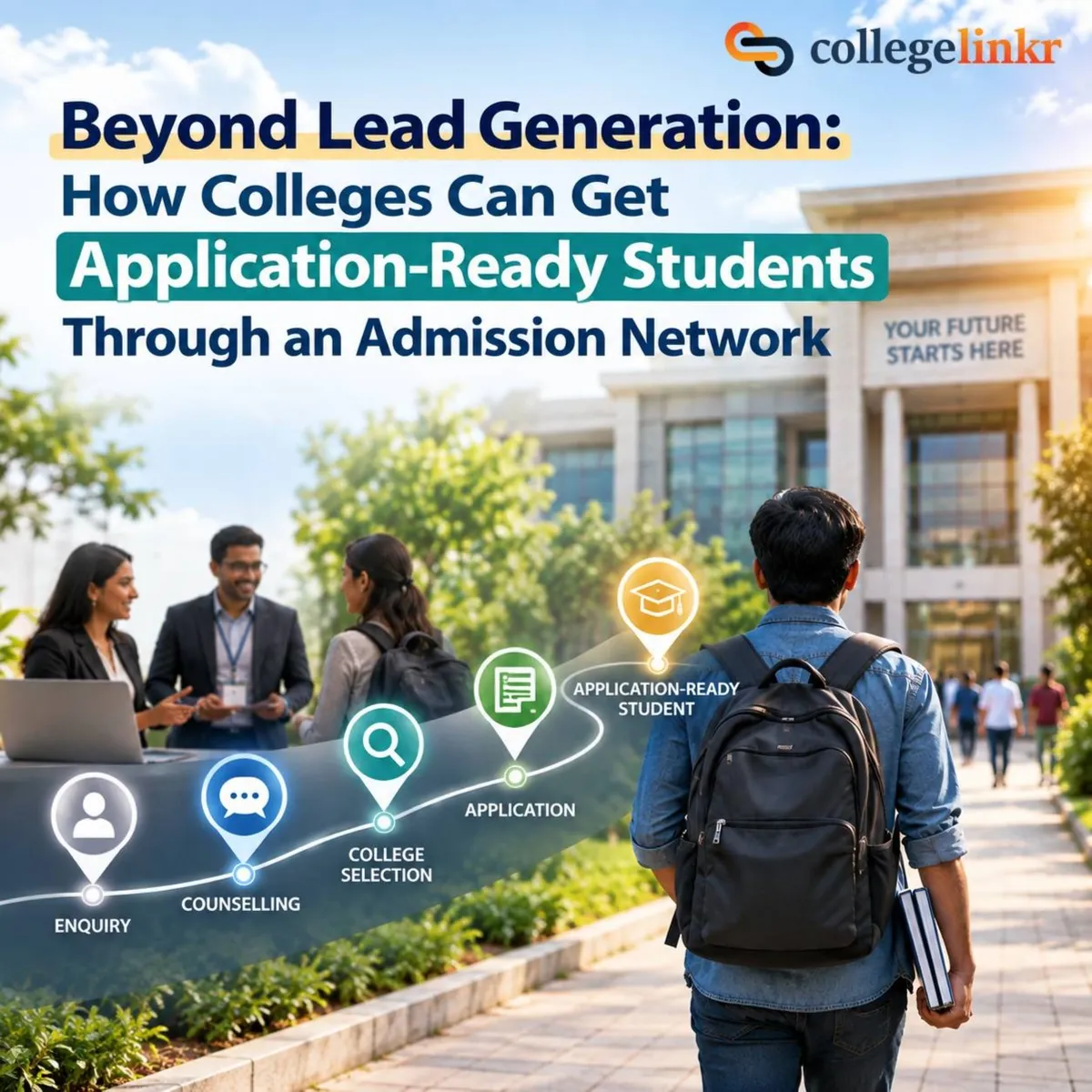
Beyond Lead Generation: How Colleges Can Get Application-Ready Students Through an Admission Network

Generating admission leads is only the beginning. Colleges need to focus on moving genuine prospective students from enquiry to counselling, college selection, eligibility checks and application. An organised admission network can connect colleges with admissi…
Why Lead Generation Is Only the First Step?
For most colleges, generating admission leads is only the beginning.
A student may fill out an enquiry form, request a brochure, ask about fees or speak to a counsellor. But none of that necessarily means the student is ready to apply.
Between the first enquiry and an actual admission, there can be several steps:
Student enquiry → Counselling → College selection → Eligibility check → Document collection → Application → Follow-up → Admission
This is where many college admission marketing strategies need to look beyond lead volume.
A college may receive hundreds of enquiries and still have a relatively small number of students who complete applications. The challenge, therefore, is not always "How can we generate more admission leads?"
Sometimes the better question is:
"How can we move genuine prospective students further down the admission funnel?"
That is where an admission network can offer a different approach.
Instead of functioning only as a lead-generation channel, an admission network can connect colleges with admission consultants, counsellors and other education professionals who can help students explore suitable colleges and move through the application process.
For colleges looking to improve student admissions, expand their reach and make their college admission process more structured, this distinction matters.
Lead Generation Is Important - But a Lead Is Not an Application
A lead tells you that someone has shown interest.
An application tells you that the student has taken a much more concrete step.
That difference is easy to overlook.
Imagine a student searching for an MBA programme.
They may submit enquiries to five colleges.
One college sends a brochure.
Another calls twice.
A third sends a WhatsApp message.
The student may still be undecided.
Now consider what happens when the student is already speaking with an admission consultant who understands their academic background, budget, preferred location and career objectives.
The conversation can become more specific:
"Which MBA programme fits my profile?"
"What are the eligibility requirements?"
"What documents do I need?"
"How do I apply?"
"What happens after I submit the application?"
That is a very different stage of the college admission funnel.
The objective isn't simply to create another lead. It is to help a genuine prospect move toward an informed application.
What Is an Application-Ready Student?
An application-ready student is not simply someone who has clicked an advertisement or submitted a lead form.
For a college, a more useful prospect is someone who:
- Has a genuine interest in a particular programme
- Understands the basic course offering
- Meets, or appears likely to meet, the stated eligibility criteria
- Has considered factors such as fees, location and mode of study
- Is willing to take the next step
- Can provide the information or documents required for an application
- Is actively considering admission
This doesn't mean every application-ready student will eventually enrol.
Students can change their plans. They may choose another college, defer admission, change courses or decide not to pursue higher education at that time.
But there is an important difference between student intent and a simple marketing enquiry.
That difference is exactly where an effective admission partner network can add value.
Why Colleges Need More Than Traditional Lead Generation?
Traditional college admission marketing often revolves around a familiar cycle:
Advertise → Generate leads → Call leads → Follow up → Convert
It works, but the college team is frequently responsible for almost everything after the lead arrives.
The admissions team may have to:
- Call the student
- Understand their requirements
- Explain the programme
- Answer questions about fees
- Explain eligibility
- Send application information
- Follow up on documents
- Remind the student to complete the application
- Track application status
- Follow up again if the application is incomplete
When enquiry volumes rise during an admission season, this can become difficult to manage consistently.
And this is where the idea of an admission network for colleges becomes interesting.
Instead of relying entirely on the college's internal team to take every prospective student from enquiry to application, colleges can work with an external network of people who already interact with students and parents.
That creates another layer between student discovery and college admission.
What an Admission Network Actually Does?
An admission network can bring together three groups:
Students + Admission Professionals + Colleges
Each has a different role.
Students
Students receive assistance in exploring relevant programmes and colleges and understanding the next steps in the admission process.
Admission Consultants and Counsellors
They help students understand their options, answer questions and facilitate the application journey.
Colleges
Colleges gain another channel through which prospective students can discover their programmes and submit applications.
The result is a more connected student admission process.
The important point is that the network should not simply push students toward whichever college pays the most.
The student's requirements should remain central.
A responsible admission professional should consider factors such as:
- Course suitability
- Eligibility
- Fees
- Location
- Mode of study
- Academic background
- Career objectives
- Other relevant student preferences
That makes the admission network more than a distribution channel. It can become part of the student decision-making journey.
From Lead to Application: Where the Real Work Happens
Consider a typical student journey.
Stage 1: The Student Discovers a Programme
The student may find an MBA, BCA, B.Tech, B.Com, nursing or another programme through search, advertising, social media, referrals or an education professional.
At this point, intent can vary considerably.
Some students are only researching.
Others are actively comparing colleges.
A smaller group may already be looking for a place to apply.
Stage 2: The Student Talks to Someone
This is where an admission consultant or counsellor can become valuable.
Instead of the student navigating dozens of college websites alone, they can discuss their requirements with someone familiar with the admission process.
Stage 3: Relevant Colleges Are Shortlisted
The student can compare options based on factors that matter to them.
This is important because "more leads" isn't necessarily the same thing as "more suitable students."
Stage 4: Eligibility and Requirements Are Checked
Before an application is submitted, basic eligibility and application requirements can be reviewed.
This can help reduce avoidable back-and-forth later in the process.
Stage 5: The Application Is Submitted
Now the prospect has moved beyond an enquiry.
The student has taken a concrete action toward admission.
Stage 6: Follow-Up Continues
An application may still require documents, payment, verification or additional steps.
Tracking these stages becomes particularly important during busy admission periods.
This is the difference between simply generating college admission leads and managing a broader admission conversion process.
Why Application Tracking Matters for Colleges?
One of the biggest problems with admissions is not always a lack of enquiries.
It can be a lack of visibility.
A college may know that a student enquired.
But what happened afterwards?
Did the student:
- Receive counselling?
- Choose a programme?
- Start an application?
- Submit documents?
- Complete the form?
- Pay the required fees?
- Drop out of the process?
- Enrol somewhere else?
A structured admission platform can make these stages easier to follow.
CollegeLinkr, for example, describes its platform as connecting Members, students and colleges and supporting the journey from college discovery through application tracking and confirmed enrolment. Its member terms define an application as a student's submission of interest or formal application through an application link and distinguish this from a confirmed admission/enrolment.
That distinction is useful for colleges because lead, application and admission are three different stages.
Treating them as the same metric can make an admission marketing campaign look better on paper than it actually is.
Application-Ready Students Can Make the Admission Funnel More Meaningful
Suppose two colleges each receive 1,000 enquiries.
Looking only at the number of leads, they appear to have generated the same result.
But imagine:
College A
1,000 enquiries
→ many students only researching
→ repeated follow-ups
→ incomplete applications
→ significant counselling workload
College B
1,000 enquiries
→ stronger qualification and counselling
→ more students progressing to applications
→ better visibility of application status
→ admissions team focuses on students who have taken concrete steps
The important metric isn't simply the number at the top.
It is what happens as students move through the funnel.
This is why colleges increasingly need to think about admission conversion, application conversion and student acquisition together rather than treating lead generation as the final objective.
How an Admission Network Can Extend a College's Reach?
A college's internal admissions team has limits.
There are only so many calls that can be made. Only so many counselling conversations can happen in a day. And during peak admission periods, the volume can rise quickly.
An external admission network can provide another route to students.
Admission consultants, counsellors and education professionals may already be interacting with students who are:
- Looking for undergraduate courses
- Exploring postgraduate programmes
- Comparing MBA colleges
- Searching for BCA colleges
- Considering B.Tech programmes
- Exploring professional courses
- Looking for online or other higher-education programmes
Instead of the college having to find every student directly, the network can create additional points of connection.
This can be especially useful for colleges trying to reach students outside their immediate geographic market.
Why This Model Can Be Different From Paying for Leads?
There is an important distinction between buying leads and building an admission network.
A lead-generation company may primarily deliver contact information and enquiry data.
An admission network can go further by connecting the student with people involved in the counselling and application journey.
The difference can be represented simply:
Lead Generation
Student → Lead → College
Admission Network
Student → Counsellor/Member → Relevant College → Application → Admission
The second model doesn't eliminate the need for the college's admissions team.
Instead, it can complement the college's existing process.
The college still evaluates applications, verifies information and makes admission decisions according to its own policies and requirements.
The network helps create and manage the pathway leading toward that application.
What CollegeLinkr Offers Colleges?
CollegeLinkr positions itself as an admissions network connecting admission consultants, students and verified colleges through one platform.
For colleges, the platform model includes free college listing and promotion across its member network, with support around counselling, document collection and form submission. Colleges reward confirmed admissions rather than paying simply for a listing.
For a college, that creates a potentially useful combination:
College visibility + admission professionals + student access + application support + admission tracking
The exact process, eligibility and commercial terms should always be checked with CollegeLinkr and the participating college before registration.
The larger idea, however, is straightforward.
A college doesn't necessarily have to choose between:
"Generate leads"
and
"Handle admissions internally."
There can be an additional layer in between — an organised admission network.
What Colleges Should Look for in an Admission Network?
Not every admission platform or education referral network operates in the same way.
Before partnering with one, colleges should ask practical questions.
1. Who is in the network?
Are the partners admission consultants, counsellors, educators, students, freelancers or general marketers?
The nature of the network matters.
2. How are applications tracked?
A college should be able to understand where a student is in the admission journey.
3. How is attribution handled?
If multiple people interact with the same student, the college needs clarity around referral and application attribution.
4. What happens after a lead is generated?
Does the platform stop at sharing contact information, or does it support the application journey?
5. How are student documents handled?
Student information is sensitive. Colleges should understand how information is collected, transferred and processed.
6. What counts as a confirmed admission?
Commercial terms should clearly define the event that triggers any payment or service charge.
CollegeLinkr's published Member Terms, for example, define an admission/enrolment in relation to completion of the application process, payment of applicable fees and the absence of a subsequent refund or reversal.
Clear definitions reduce confusion for everyone involved.
The College Admission Funnel Is Changing
India's higher-education ecosystem is large and continues to expand. The Ministry of Education's Annual Report 2024–25 cites provisional AISHE 2022–23 data showing nearly 4.46 crore students enrolled in higher education, compared with 3.42 crore in 2014–15.
For colleges, this means the student opportunity is substantial — but so is the competition for student attention.
Students have more information available to them than ever.
They can compare colleges, programmes, fees, locations, eligibility requirements and career options before making a decision.
That changes what colleges need from admission marketing.
Visibility matters.
Lead generation matters.
But the ability to help a serious prospect move from interest to application matters too.
The Bigger Opportunity: Build an Admission Ecosystem, Not Just a Lead Pipeline
There is a subtle but important change in thinking here.
A lead pipeline asks:
"How many students can we bring in?"
An admission ecosystem asks:
"How can we help the right students discover, understand, apply to and ultimately enrol in suitable programmes?"
The second question is broader.
It involves marketing, counselling, applications, follow-up and admissions working together.
For colleges, this can mean less dependence on a single student acquisition channel.
For admission consultants, it can provide access to a wider range of colleges and structured application processes.
For students, it can make the process easier to navigate.
Everyone still has a separate role — but the journey becomes more connected.
What This Means for College Admission Marketing?
The future of college admission marketing isn't necessarily about generating the largest possible number of leads.
It is about building a system in which the right prospective students can move efficiently through the admission funnel.
That means colleges should think about:
Reach — Are students discovering your programmes?
Relevance — Are the students being connected with programmes that actually fit their requirements?
Counselling — Are their questions being answered?
Application — Are interested students completing the next step?
Tracking — Can the college see what is happening after the initial enquiry?
Conversion — How many applications ultimately become confirmed admissions?
An admission network can sit across several of these stages.
That makes it worth considering as part of a broader student recruitment strategy.
Final Thoughts: Stop Measuring the Journey Only at the Lead Stage
A lead is a beginning, not an outcome.
For colleges trying to increase student admissions, the real opportunity lies in improving what happens after that first enquiry.
When students receive relevant guidance, understand their options, complete the required steps and move toward an application, the college gets something more valuable than another name and phone number.
It gets a prospect who has taken a meaningful step toward admission.
That is why application-ready students deserve more attention in today's college admission strategy.
An organised admission network can help colleges extend their reach while creating a more structured bridge between students, admission professionals and institutions.
CollegeLinkr is built around this model: connecting colleges with Members and students and supporting the journey from college discovery and application through confirmed admission.
And for professionals participating in the network, the model can also create an additional performance-based earning opportunity. It may even appear alongside searches for an Earn Money Online App, but the important distinction is that this is not a generic earning app or guaranteed-income scheme; CollegeLinkr's model is tied to eligible admissions and applicable terms.
For colleges, the takeaway is simpler:
Don't ask only how many leads your admission campaign generated.
Ask how many genuine students moved from enquiry → counselling → application → admission.
That is where a lead becomes an admission opportunity.
Frequently Asked Questions
Grow Your Admissions With CollegeLinkr
Every seat left empty is revenue your campus never sees.
Become a partner college and fill more seats — with less effort.
Free to list · No marketing spend · Pay only on confirmed admission