
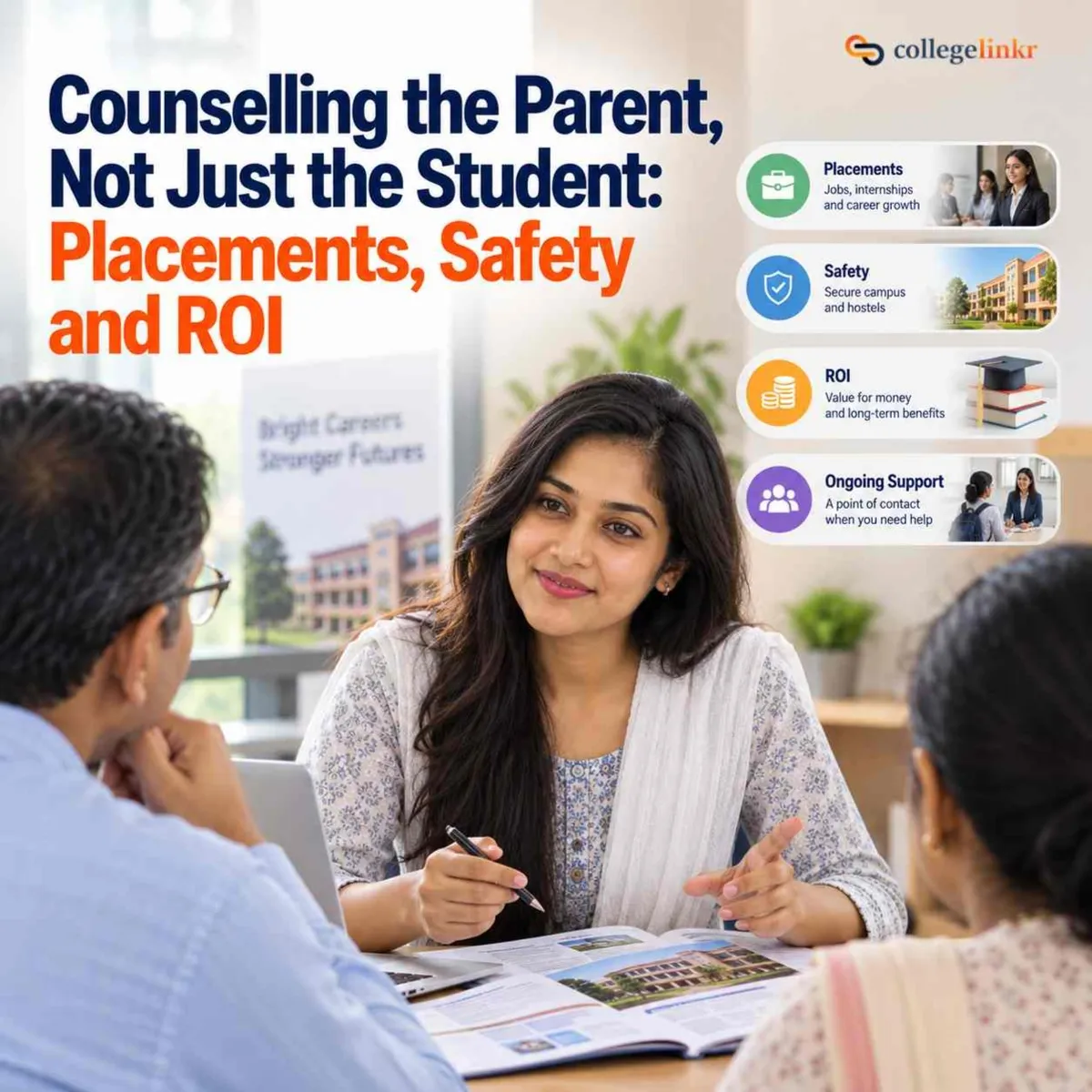
Counselling the Parent, Not Just the Student: How Admission Teams Can Answer Family Concerns on Placements, Safety and ROI

In Indian admissions, the student chooses the course but the family often makes the final call. Parents ask about recognition, safety, placements and whether the fees are worth it. This guide helps admission teams understand what parents really worry about and…
Why Parents Shape the Final Decision?
A student may fall in love with a course after one campus visit. But in most Indian families, the decision does not end there. Parents, and sometimes grandparents, uncles or older siblings, weigh in. They are often the ones paying, taking the loan or making the sacrifices that make college possible.
That gives them a strong voice. An admission team that speaks only to the student may win enthusiasm but lose the admission. A team that understands and addresses the family's concerns is far more likely to see that student on the first day of class.
Counselling parents well is not about persuasion. It is about answering the questions they are actually asking, honestly and with evidence.
The Five Questions Almost Every Parent Asks
Parents rarely phrase their concerns as neat questions, but most conversations come back to the same five themes.
1. Is this college genuine and recognised?
This comes first, and it is non-negotiable. Families have heard stories about institutions that turned out to be unrecognised. The University Grants Commission publishes a public list of fake universities that are not authorised to award degrees, which as of February 2026 contains 32 entries. Many parents now check recognition themselves before paying anything.
2. Will my child be safe here?
Safety covers hostels, campus security, travel, ragging and, for daughters in particular, a secure environment. Parents sending a child to another city carry a great deal of worry.
3. What happens after the course?
Parents want to know whether the course leads to jobs, higher studies or a stable career. Placement records, internship links and alumni outcomes all matter here.
4. Is the cost worth it?
Families compare fees with expected outcomes. They want to know the full cost, the available financial help and whether the investment makes sense for their child.
5. Who can we call if something goes wrong?
Parents want a person, not a general helpline. They want to know who will answer if their child is unwell, struggling academically or facing a problem on campus.
Also Read
- Struggling to Fill MBA Seats? Partner with CollegeLinkr and Connect with 10,000+ Admission Consultants Across India
- Planning a January Intake? How to Fill a Second Admission Cycle Under UGC's Biannual Admission Rules
- Who Really Brought This Student? Ending Agent Disputes and Double Commissions With Traceable Admissions
- Eligibility Mismatches Cost More Than You Think: Why Pre-Screened, Document-Complete Applications Protect Your Admissions Office
- Too Many Eggs in One Agent's Basket: How Colleges Can Reduce Dependence on a Single Agent or Region
- Why Niche Programmes Struggle to Fill Seats, and How Guided Counselling Changes That
- How to Handle Peak-Season Admissions Without Hiring More Counsellors
How to Answer Questions About Recognition?
Share approval letters, affiliation details and recognition numbers. Point parents to official regulator websites where they can verify the information themselves.
Explain what each approval means
Most parents do not know the difference between an affiliation, an approval and accreditation. A short, plain explanation builds confidence and shows the college has nothing to hide.
Never overstate status
If a programme is newly approved or awaiting a particular accreditation, say so. Parents respect honesty far more than vague claims they later discover to be untrue.
How to Answer Questions About Safety?
Explain where students live, how hostels are supervised, visiting rules, mess arrangements and medical support. Specific details reassure more than general promises.
Explain your anti-ragging system clearly
In July 2026, UGC wrote to all higher education institutions asking for strict compliance with its anti-ragging regulations. Institutions are expected to have functioning anti-ragging bodies, display the 24x7 toll-free helpline 1800-180-5522, collect anti-ragging undertakings from students and parents online, and act promptly on complaints. Walk parents through how your college does each of these.
Address the concerns of families sending daughters
Ministry of Education data shows that female Gross Enrolment Ratio in higher education reached 31.2 in 2023-24, higher than the male GER. More families than ever are sending daughters to college, often to other cities. Explain women's hostel security, transport arrangements, grievance committees and the women staff available to support students.
Share how the college handles emergencies
Tell parents what happens if a student falls ill, who is informed and how quickly. Knowing there is a plan matters enormously to a parent far away.
How to Answer Questions About Placements and Careers?
If you publish placement figures, include the batch year, number of eligible students, number placed and the range of roles. Families are increasingly sceptical of single "highest package" figures.
Talk about career paths, not just packages
For many courses, the most useful answer explains typical first roles, how careers grow and what higher-study options exist. This is especially important for specialised programmes parents are unfamiliar with.
Mention internships and industry links
Named partner companies, internship programmes and guest lecture series show that the college connects students to the working world.
Be realistic
Avoid guarantees. Parents remember promises, and broken ones damage reputations quickly. Honest expectations lead to fewer complaints and stronger referrals.
How to Answer Questions About Cost and ROI?
Share one complete fee sheet covering tuition, hostel, mess, exams and deposits, with year-wise and total figures.
Explain financial support
Tell families about the college's scholarships, government schemes on the National Scholarship Portal and education loan options. Under the PM-Vidyalaxmi scheme, students admitted to eligible quality higher education institutions can access collateral-free and guarantor-free education loans, and families with income up to ₹8 lakh can receive 3% interest subvention on loans up to ₹10 lakh. If your college is on the eligible list, say so clearly.
Help families think about value, not just price
Parents often compare colleges by fee alone. Help them weigh faculty, practical training, safety, location, career support and total cost together.
Communication Tips for Parent Conversations
- Speak in the family's preferred language wherever possible.
- Give parents time to ask questions without rushing towards a decision.
- Share written information they can review later and show relatives.
- Offer a campus visit or a video call with a faculty member or warden.
- Provide a named contact person for follow-up questions.
- Follow up after admission with information about orientation, hostel check-in and key contacts.
The Role of Trusted Local Counsellors
Many parents, especially in smaller cities, prefer to discuss college choices with a local education consultant they already know. These consultants often become the bridge between the family and the college, explaining options in familiar terms and answering questions in person.
Colleges that work with consultants through a structured network, such as CollegeLinkr, can make sure those conversations are based on accurate, current information about courses, fees and eligibility. When a trusted local counsellor and a transparent college give parents the same clear answers, families commit with far more confidence.
Final Thoughts
Parents are not obstacles in the admission process. They are partners in it. Their questions about recognition, safety, careers and cost are the same questions any responsible family should ask.
Admission teams that welcome those questions, answer them honestly and back their answers with evidence build something more valuable than a single admission. They build a reputation among families, and in India, that reputation travels further than any advertisement.
Resources
- List of fake universities (University Grants Commission)
- UGC letter on strict implementation of anti-ragging regulations, July 2026 (University Grants Commission)
- Union Ministry of Education releases AISHE 2022-23 and 2023-24 reports (Press Information Bureau)
- Cabinet approves PM-Vidyalaxmi scheme (Ministry of Education)
If parents in your community trust you to guide their child's college choice, download the CollegeLinkr App to recommend verified colleges, submit applications and keep families updated at every step.
Frequently Asked Questions
Grow Your Admissions With CollegeLinkr
Every seat left empty is revenue your campus never sees.
Become a partner college and fill more seats — with less effort.
Free to list · No marketing spend · Pay only on confirmed admission