
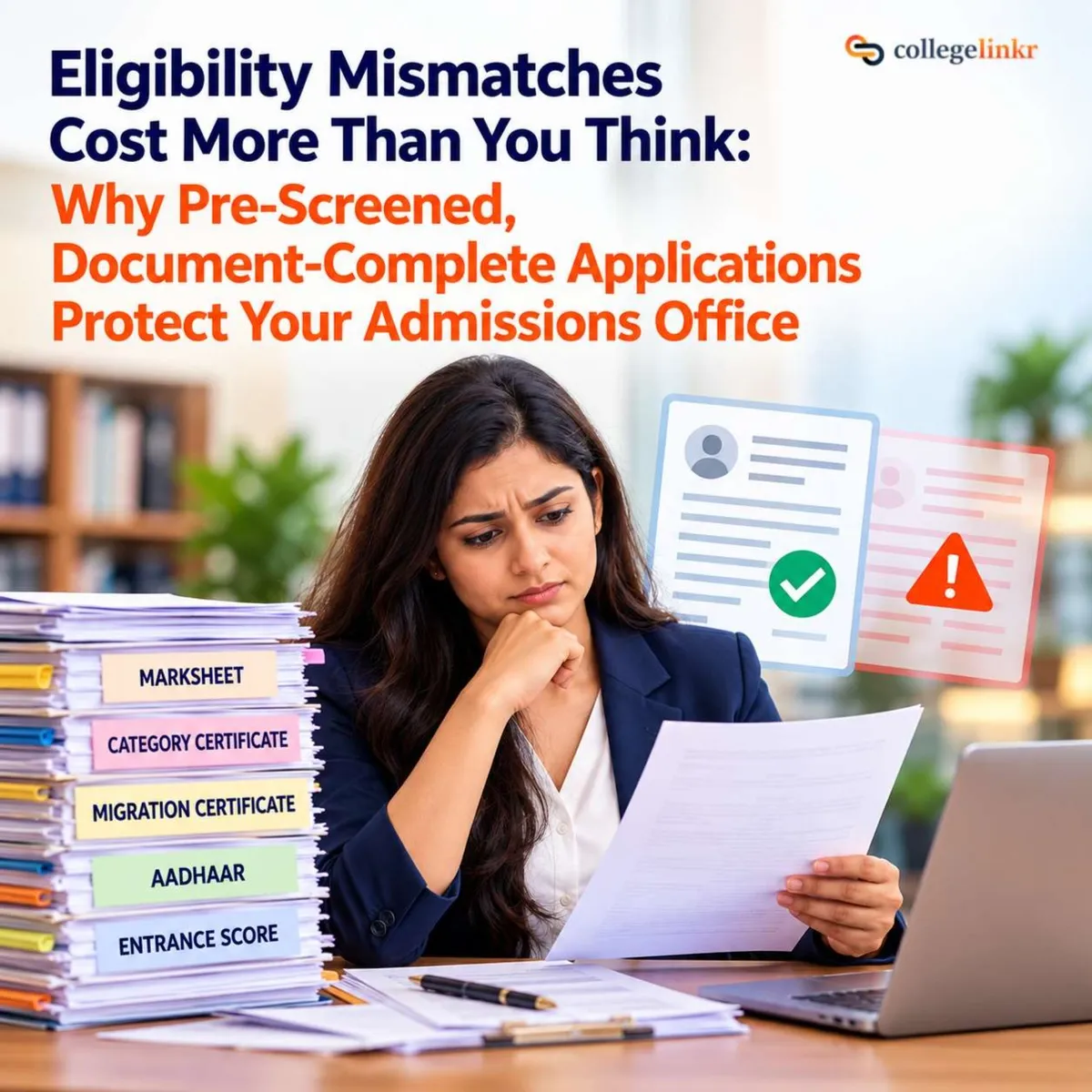
Eligibility Mismatches Cost More Than You Think: Why Pre-Screened, Document-Complete Applications Protect Your Admissions Office

A student admitted in August and found ineligible in October costs a college a seat, staff time, a refund and some reputation. This article explains where admission eligibility mismatches and document gaps come from, what UGC rules say about original certifica…
The Admission That Fell Apart in October
A student joins a B.Sc. Allied Health programme at a college in Belagavi in August. Fees paid, hostel room allotted, classes started. In October, the affiliating university's eligibility approval comes back. Her marks in the required Class 12 subjects fall short of the programme minimum by a whisker. She can't continue.
Now the college has an upset family, a refund to work out, a seat that's empty after every counselling round has closed, and a front-desk executive who accepted an application nobody checked properly.
Nobody did anything dramatic. That's exactly why it's so common.
Where Eligibility Mismatches Actually Come From
In my experience, very few eligibility problems involve fake documents. Most come from small, dull gaps that nobody owned:
- Board equivalence. CBSE, ICSE, state boards, NIOS and foreign boards report marks differently, and someone has to confirm the qualification is recognised by your university.
- Subject combinations. "Biology" and "Biotechnology" aren't interchangeable for every programme. Neither are "Mathematics" and "Applied Mathematics".
- How the percentage is worked out. Is the minimum on the aggregate, on core subjects, or on core subjects plus English? Families tend to calculate it whichever way helps them.
- Category relaxations claimed without a valid certificate, or with one from another state that your state doesn't recognise.
- Gap years, age limits and the validity period of entrance scores.
- A name or date of birth that differs between the Class 10 certificate, the Class 12 marksheet and Aadhaar.
- A missing migration or transfer certificate for a student coming from another board or university.
And the rules are becoming more varied, not less. Under the UGC (Minimum Standards of Instruction for the Grant of Undergraduate Degree and Postgraduate Degree) Regulations, 2025, a student can be eligible for a UG programme in any discipline if she qualifies the relevant national or university-level entrance examination, irrespective of the subjects she studied in Class 12, and institutions may offer bridge courses. That flexibility is good news for students. It also means your front desk can't lean on old shortcuts like "science only" any more.
What One Mismatch Really Costs
Add it up honestly. Hours of staff time on calls, re-verification and letters to the university. A seat you can't refill because the main rounds are over. Possibly a grievance. And a refund, whose size depends on timing.
The refund clock
UGC's fee refund rules are tied to dates. For the 2024-25 session, UGC required a full refund on cancellations up to 30 September and allowed a processing deduction of no more than ₹1,000 up to 31 October, and its 2025-26 notice kept that policy in force. For admission schedules that run beyond that cut-off, the table in UGC's October 2018 notification applies instead, stepping down from a full refund to nothing once more than 30 days have passed after the notified last date of admission.
When an ineligible student is caught late, arguments about who was at fault get ugly fast. Catch the problem before admission and there's no refund conversation at all.
What you can and can't do with original certificates
Some colleges try to protect themselves by holding on to original certificates. Don't. UGC's 2018 notification, reproduced in its 2025-26 refund notice, says institutions can't insist on original certificates when the admission form is submitted, though self-attested copies are mandatory. Originals must be physically verified in the student's presence at the time of admission and returned immediately. If there's doubt, the institution can refer the certificate to the board or university that issued it. What it can't do is keep the original, under any circumstance.
So verification has to happen early, and it has to be done properly. Keeping documents as security isn't an option.
Also Read
- Too Many Eggs in One Agent's Basket: How Colleges Can Reduce Dependence on a Single Agent or Region
- Education Consultants vs an Admission Network: What Colleges Should Know Before Choosing a Partner
- Filling Seats After the Main Counselling Rounds: How Colleges Can Recover Vacancies from Withdrawals and Late Cancellations
- How Colleges Can Reach Students in Tier-2 and Tier-3 Cities Without Opening Regional Offices
- 8 Higher Education Marketing Strategies to Boost Student Enrollment in 2026
Pre-Screening That Actually Works
The fix is to check eligibility before a family pays anything. Here's the checklist I'd use for every programme:
- An eligibility matrix per programme: accepted boards, required subjects, minimum marks and exactly how they're calculated, entrance exams accepted, age limits and category relaxations.
- A document list per programme, matched line by line to that matrix.
- A name and date-of-birth check across every document before the application is accepted.
- Digital verification wherever it's available.
That last point is far easier than it was a few years ago. A PIB factsheet on the National Academic Depository (NAD) explains that institutions upload verified academic records to NAD through DigiLocker, students share them only with explicit consent, and authorised organisations can verify their authenticity directly. UGC is the nodal agency implementing NAD. The Ministry of Education's APAAR portal adds that institutions use APAAR IDs to access and verify students' academic histories for admissions.
Not every board or university has uploaded every record yet. Where they have, use it. It's quicker than a phone call to a board office in another state.
Why Your Best Filter Sits Before Your Front Desk
Your admissions office sees a student for perhaps twenty minutes. A good counsellor spends hours with the family before that, which is exactly where eligibility should be checked first.
CollegeLinkr is built on that idea. Members, the admission consultants on the network, handle student counselling, document collection and form submission. Applications reach the college eligibility-checked against the criteria you've shared, and document-complete, through a single dashboard. You pay only when an admission is confirmed.
Your team still does the final verification. That responsibility is yours, and it should stay that way. But checking a complete, pre-screened file is a very different job from chasing a missing migration certificate in October.
One honest caveat. Pre-screening is only as good as the eligibility details you share. Vague criteria produce vague screening, so be exact.
Build the Eligibility Matrix This Week
Pick your three highest-intake programmes. For each one, write the eligibility matrix and document list described above, and ask your affiliating university's eligibility section to confirm them in writing. Then share exactly the same criteria when you list those programmes on CollegeLinkr, so every application gets screened against the rules your university will actually apply.
Resources
- UGC Fee Refund Policy for Academic Session 2025-26 (includes the October 2018 notification)
- UGC (Minimum Standards of Instruction for the Grant of UG and PG Degree) Regulations, 2025
- National Academic Depository (NAD): PIB Factsheet
- APAAR FAQs, Ministry of Education
If you're an admission consultant who checks eligibility properly before sending a student anywhere, download the CollegeLinkr App to see each college's eligibility criteria, submit document-complete applications and track every student through to admission.
Frequently Asked Questions
Grow Your Admissions With CollegeLinkr
Every seat left empty is revenue your campus never sees.
Become a partner college and fill more seats — with less effort.
Free to list · No marketing spend · Pay only on confirmed admission