
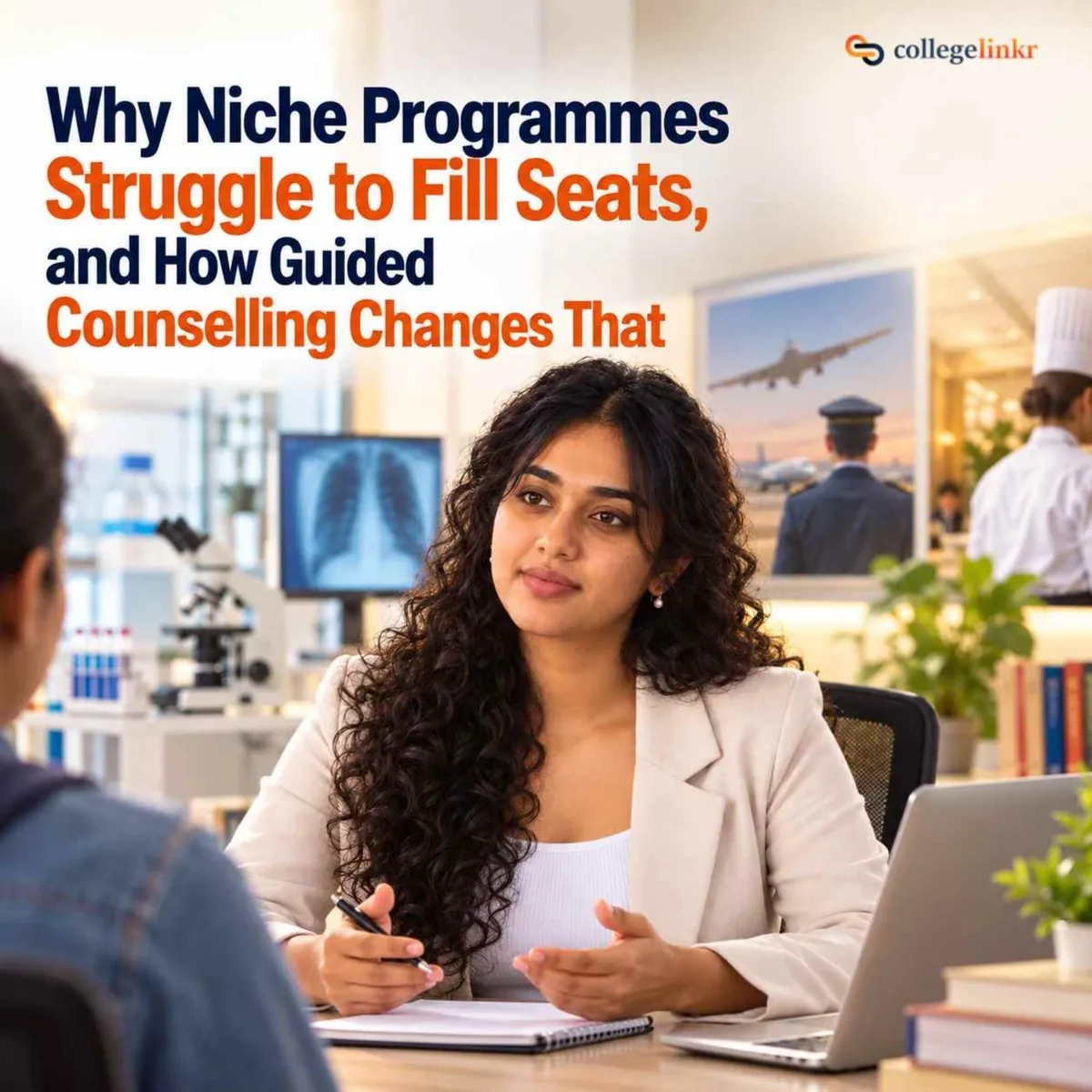
Why Niche Programmes Struggle to Fill Seats, and How Guided Counselling Changes That

Programmes like allied health sciences, forensic science, aviation, yoga therapy and hospitality often have good career prospects and empty seats at the same time. The problem is rarely quality. It is that students and parents do not understand the course. Thi…
Good Courses, Empty Seats
Walk into the admissions office of almost any multi-disciplinary college in June and you will see a familiar pattern. Engineering, commerce and management seats move quickly. Programmes such as B.Sc Medical Lab Technology, Optometry, Cardiac Care Technology, Forensic Science, Aviation Management or Yoga Therapy move slowly, sometimes painfully so.
It is tempting to assume demand is the issue. Usually it is not. Many of these fields have real and growing need for trained professionals. The gap lies somewhere else: most students have simply never had these careers explained to them, and their parents have even less context.
When a family does not understand a course, they do not choose it. And no amount of banner advertising can fix a gap in understanding.
Also Read
- Education Consultants vs an Admission Network: What Colleges Should Know Before Choosing a Partner
- How to Handle Peak-Season Admissions Without Hiring More Counsellors
- The Real Cost of an Empty Seat: How Much Revenue Your College Loses Every Admission Cycle
- Filling Seats After the Main Counselling Rounds: How Colleges Can Recover Vacancies from Withdrawals and Late Cancellations
- New College, No Brand Yet? How First-Cycle Institutions Can Build Student Trust and Fill Their First Batch
- How Colleges Can Reach Students in Tier-2 and Tier-3 Cities Without Opening Regional Offices
- How Colleges Can Reduce Marketing Costs with Pay-on-Admission Model?
- Beyond Lead Generation: How Colleges Can Get Application-Ready Students Through an Admission Network
Why Niche Programmes Are Hard to Fill
Every student knows what a doctor, engineer or chartered accountant does. Far fewer know what a perfusionist, dosimetrist, dialysis therapy technologist or clinical coder does day to day, where they work or how they grow. Without a picture of the job, the course feels like a gamble.
Parents worry about recognition and scope
Families often ask whether a programme is "valid", whether it leads to a government job, and whether it will still matter in ten years. These concerns are reasonable, and they need careful answers.
Similar names cause confusion
A diploma, a B.Sc, a B.Voc and a certificate course in the same field can sound almost identical. Students struggle to tell which one suits their eligibility and goals.
Ads cannot answer follow-up questions
An advertisement can tell a student that a course exists. It cannot sit with a confused parent, answer the fifth question about salary or reassure a student who is unsure whether biology marks are enough.
The Allied Health Example: A Field That Has Become More Structured
Allied and healthcare programmes are a good illustration of how the landscape is changing. The National Commission for Allied and Healthcare Professions Act, 2021 set up a dedicated regulatory framework for these professions in India. Its Schedule lists ten recognised categories, including medical laboratory and life sciences, trauma and burn care, surgical and anaesthesia-related technology, physiotherapy, nutrition science, ophthalmic sciences, occupational therapy, medical radiology and imaging, medical technologists and physician associates, and health information management.
The Act also defines what these qualifications should involve. An allied health professional's diploma or degree must cover at least 2,000 hours spread over two to four years, while a healthcare professional's degree must cover at least 3,600 hours over three to six years. The law provides for central and state registers of professionals.
For colleges, this is useful material. A structured, regulated pathway is exactly the kind of reassurance parents look for. But it only helps if someone explains it to them in plain language.
Why Guided Counselling Works Better Than Advertising
Guided counselling means a trained person talks a student and family through a course, its career path and its fit for that particular student. It is slower than advertising, but it is far more effective for programmes that need explaining.
It turns a course name into a career story
A counsellor can describe what a radiology technologist does on a typical day, what kind of hospitals hire them and how the role can grow. Suddenly the course becomes a job the student can imagine.
It matches the right student to the right programme
Not every student should take a niche course. A good counsellor checks interests, marks and eligibility, and recommends the programme only when it fits. That leads to fewer dropouts later.
It handles parents' concerns directly
Questions about recognition, government jobs, salary and future scope can be answered one by one, in the family's own language. That is where most decisions are actually made.
It builds commitment before the student arrives
Students who choose a niche course after a proper conversation tend to arrive with clearer expectations. They are more motivated and less likely to switch programmes mid-way.
What Counsellors Need From Colleges to Explain Niche Programmes Well
Counsellors can only explain what they understand. Colleges that give them good material see better results.
A clear one-page course explainer
Cover what the course teaches, how long it runs, the eligibility, the practical training and the kinds of roles graduates take up. Avoid jargon wherever possible.
Honest career and further-study pathways
Explain which jobs graduates typically enter, which sectors hire them, and what options exist for higher studies. Be realistic about starting roles.
Details of practical exposure
For clinical and technical programmes, hospital tie-ups, lab hours and internships are major selling points. Name partner institutions if you can.
Regulatory and recognition information
Mention the relevant regulator, university affiliation and approvals. For allied health courses, it helps to explain how the programme aligns with the recognised categories under the NCAHP Act.
Eligibility in simple terms
Spell out subject requirements, minimum marks and any entrance tests. Confusion about eligibility is one of the most common reasons interested students give up.
How CollegeLinkr's Member Network Helps Niche Programmes
CollegeLinkr connects colleges with more than 10,000 education consultants, called Members, who counsel students across India. For niche programmes, this network does what advertising cannot.
- Members explain your programme to students and parents one conversation at a time, in their local context.
- They check eligibility before recommending the course, so applications come from students who are a genuine fit.
- They collect documents and submit complete applications, saving your team time.
- Your course information, eligibility and fees sit in one listing, so every Member shares consistent details.
- You pay only when a student confirms admission, at a commission you set for each course.
That last point matters for niche programmes in particular. You can set a higher commission for programmes that need more counselling effort, which encourages Members to spend time explaining them properly. One of CollegeLinkr's partner institutions offering yoga therapy and integrative health programmes has said that Members' counselling helped its seats fill faster than any other channel it had tried.
A Practical Plan for Filling Niche Programmes
- List every niche programme with its seat count and fill rate for the last two or three years.
- Create a simple course explainer for each one, written for a parent rather than an academic.
- Add career pathways, practical training details and recognition information.
- Publish the programmes on an admission network with complete and accurate details.
- Set course-wise commissions that reflect the counselling effort each programme needs.
- Run short online briefings for counsellors so they can ask questions directly to your faculty.
- Track applications by programme every week and refine your explainers based on the questions counsellors hear most often.
Final Thoughts
Niche programmes are often where a college's most distinctive strengths lie. They can lead to meaningful, in-demand careers, yet they sit half-empty because nobody took the time to explain them.
The fix is not louder advertising. It is better conversations. When colleges equip trained counsellors with clear, honest information and reward them for doing that work well, niche programmes stop being a problem to manage and start becoming a reason students choose the college.
Resources
- The National Commission for Allied and Healthcare Professions Act, 2021 (India Code)
- Union Ministry of Education releases AISHE 2022-23 and 2023-24 reports (Press Information Bureau)
- All India Survey on Higher Education portal (Ministry of Education)
If you counsel students on career choices, download the CollegeLinkr App to find verified colleges offering specialised programmes, submit applications and track each admission with ease.
Frequently Asked Questions
Grow Your Admissions With CollegeLinkr
Every seat left empty is revenue your campus never sees.
Become a partner college and fill more seats — with less effort.
Free to list · No marketing spend · Pay only on confirmed admission