
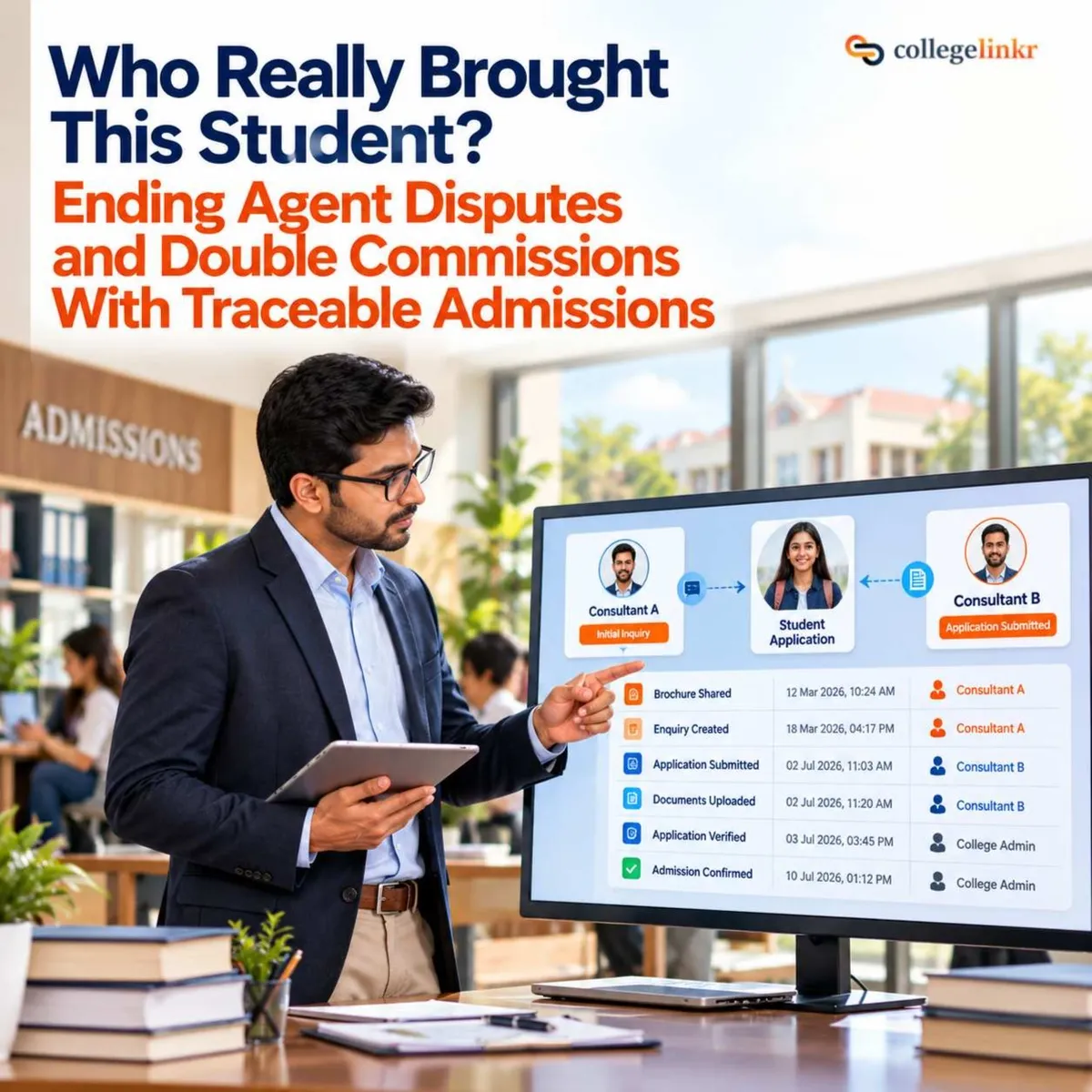
Who Really Brought This Student? Ending Agent Disputes and Double Commissions With Traceable Admissions

Two consultants, one student, two invoices. Agent commission disputes cost colleges money and goodwill every admission season. This article explains why double commissions happen, what UGC fee refund rules and the DPDP Act mean for colleges working with admiss…
Two Invoices for One Seat
It's the second week of September. Your accounts team has two invoices on the desk for the same B.Sc. Nursing student from Kottayam. One consultant says she shared your brochure with the family in March. The other says he filled in the form, sat with the father while the fee was paid and brought the girl to campus in July.
Both have WhatsApp screenshots. Both are angry. And your admissions head has to decide who gets paid, knowing the other one may never send you a student again.
If this sounds familiar, you're in good company. Most colleges that work with admission agents live through some version of it every year.
Why Attribution Disputes Keep Happening
The root cause is simple. There's no single record of who did what, and when. Look at how a typical agent-sourced admission really happens:
- First contact happens on WhatsApp, on a phone call or in a coaching centre. The college records none of it.
- Commission terms get agreed verbally, sometimes with the chairman, sometimes with the admissions head, occasionally with both, and not always on the same terms.
- Sub-agents pass students to bigger agents, and both claim the admission.
- The student walks in by herself after hearing about you from two people, and the front desk fills in the form.
- The family talks to three consultants because they want a second opinion, which is perfectly sensible from their side.
So when two people claim one admission, both are often partly right. Without a rule and a record, you're judging stories.
The Cost Goes Well Beyond a Double Payout
Paying twice hurts. Paying the wrong person can hurt more, because good consultants stop sending you students and tell other consultants why.
There are two quieter risks that deserve more attention than they get.
When the agent collects the fee
Some agents collect a "booking amount", or even the first-year fee, directly from families. UGC's Fee Refund Policy for 2024-25 says its refund guidelines also apply to organisations, consortiums, committees and associations that process admissions and collect fees on behalf of institutions, and that the institution concerned is responsible for the refund. UGC's notice for 2025-26 keeps that policy in force until a revised one is issued.
In plain words, if a student withdraws within the refund window and your agent is sitting on the money, the family comes to you, and UGC holds you responsible. The 2024-25 circular also points out that delay or denial of a refund due to a student counts as a grievance under UGC's Redressal of Grievances of Students Regulations, 2023.
Publishing your fees properly helps here. UGC's Guidelines on Public Self-Disclosure by Higher Education Institutions ask every HEI to put its prospectus, including the fee structure, its admission process and its fee refund policy on a website that anyone can open without logging in. When the real fee is public, it's much harder for anyone to quote a different number to a family in Thrissur.
Student data sitting in someone's phone
Every agent-sourced admission involves marksheets, Aadhaar copies, photographs and sometimes income certificates. Most of it travels as phone photos on chat apps.
The Digital Personal Data Protection Act, 2023 and the DPDP Rules notified in November 2025 raise the stakes on that habit. A PIB explainer on the Rules separates the Data Fiduciary, which decides why and how personal data is processed, from the Data Processor, which processes it on the fiduciary's behalf. It says every Data Fiduciary must issue a clear, separate consent notice, that organisations get an eighteen-month phased compliance period, and that failing to maintain reasonable security safeguards can attract a penalty of up to ₹250 crore.
I'm an admissions person, not a lawyer. But a college that can't say where its applicants' documents are stored, or who has copies of them, should get legal advice well before that compliance period runs out.
Also Read
- Eligibility Mismatches Cost More Than You Think: Why Pre-Screened, Document-Complete Applications Protect Your Admissions Office
- Too Many Eggs in One Agent's Basket: How Colleges Can Reduce Dependence on a Single Agent or Region
- How to Handle Peak-Season Admissions Without Hiring More Counsellors
- New College, No Brand Yet? How First-Cycle Institutions Can Build Student Trust and Fill Their First Batch
What a Traceable Admission Looks Like
Traceable doesn't mean complicated. It means every admission carries a record that answers four questions without anybody's screenshots:
- Who submitted the application? A unique, consultant-specific link or code, attached to the application from the very first step.
- When? A timestamp on the submitted application, not on a forwarded brochure.
- What was submitted? Documents uploaded against that record, not floating around in chat threads.
- What is the consultant owed, and on what event? Written terms, published upfront.
That last one is where most fights begin. "Commission" means different things to different people. Is it earned on application, on fee payment, or once the student has attended classes for a month? Pick one, write it down and apply it to everyone.
The Attribution Rule I'd Put in Every Agent Agreement
Here's my position, and you're free to disagree. Credit belongs to the consultant whose tracked link produced the complete, eligible application. Not to whoever forwarded the first brochure.
Why? Forwarding a brochure takes ten seconds. Counselling a family, collecting documents, checking eligibility and getting a form submitted takes hours. Pay for the work that leads to the admission.
A few other terms worth putting in writing:
- Commission becomes payable only on a confirmed admission, after the refund window for that session has closed.
- Agents don't collect fees from students. Every rupee goes straight to the college account.
- If a student withdraws and gets a refund, the commission is reversed.
- Sub-agent arrangements are the agent's own business. You pay one party per admission.
- Student documents reach you through your system, never over personal chat.
Five rules. Once they're signed, most disputes simply stop happening.
How CollegeLinkr Settles "Who Brought This Student?"
CollegeLinkr was designed around exactly this problem. Members, the admission consultants on the network, generate application links for listed colleges and share them with students. The dashboard tracks each student from application through to admission. Members' service charges are published upfront and released on confirmed admissions, so nobody negotiates case by case.
On the college side, listing is free, applications arrive eligibility-checked and document-complete, and you pay only for confirmed seats. When someone asks who brought a student, the answer comes from the record, not from whoever argues loudest.
Start With Last Year's Disputes
Pull every commission dispute from your last admission cycle and note what caused each one: no record, verbal terms, a fee collected by an agent, or two people claiming the same student. Rewrite your agent agreement around the five rules above before the next season opens, and move new consultant partnerships onto a tracked platform from the first application.
Resources
- UGC Fee Refund Policy 2024-25
- UGC Fee Refund Policy for Academic Session 2025-26
- DPDP Rules, 2025 Notified: PIB Explainer
- UGC Guidelines on Public Self-Disclosure by Higher Education Institutions
If you're an admission consultant tired of chasing colleges for credit on students you counselled, download the CollegeLinkr App to share tracked application links, follow every student through to admission and see your service charges before you start.
Frequently Asked Questions
Grow Your Admissions With CollegeLinkr
Every seat left empty is revenue your campus never sees.
Become a partner college and fill more seats — with less effort.
Free to list · No marketing spend · Pay only on confirmed admission