
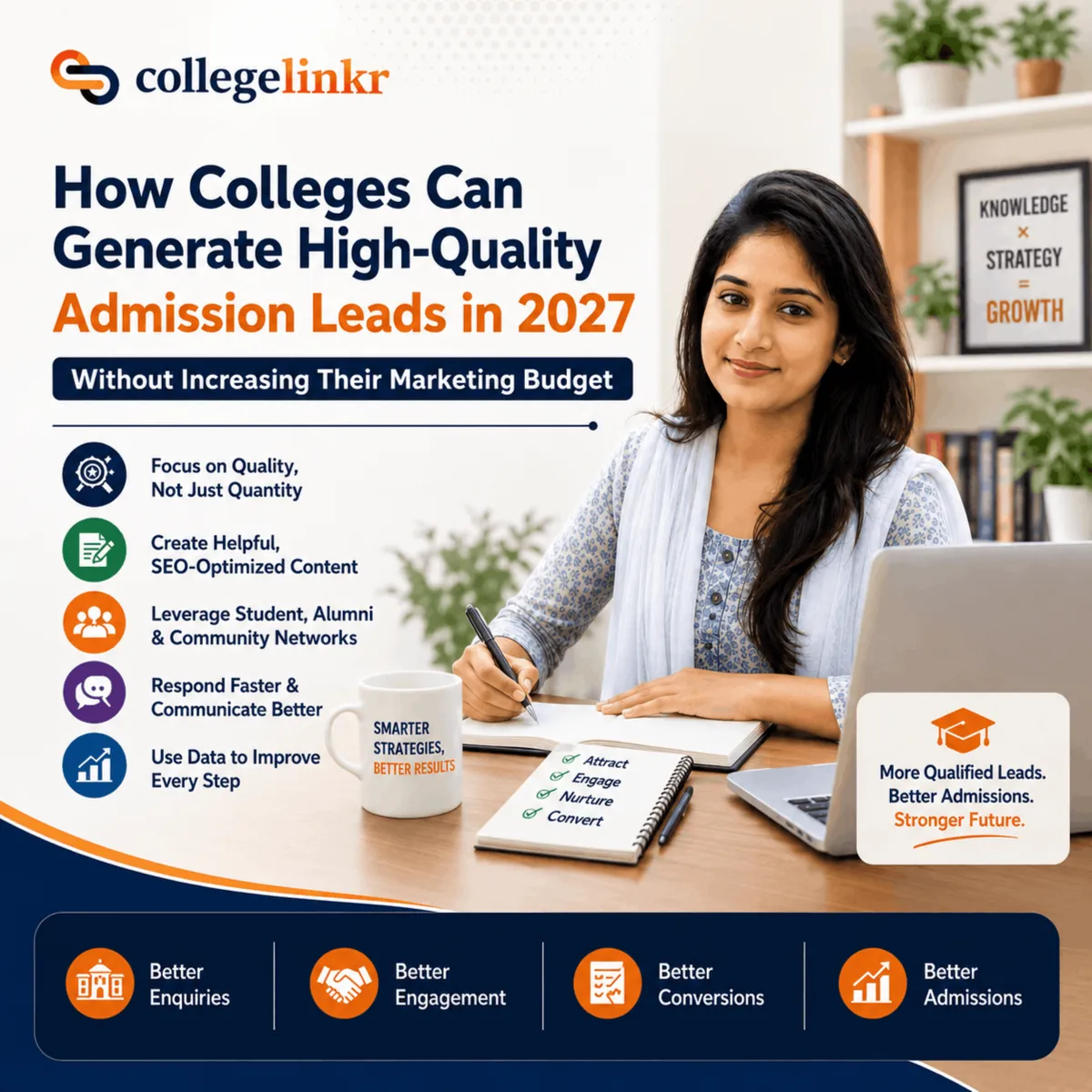
How Colleges Can Generate High-Quality Admission Leads in 2026 Without Increasing Their Marketing Budget

This guide draws on hands-on experience advising Indian colleges and universities on student recruitment strategies, higher education SEO, and admission conversion optimisation, combined with publicly available research on higher-education marketing and lead-r…
For colleges and universities in India, generating enough admission enquiries is no longer simply a matter of increasing advertising spend.
The competition for students has become intense. A prospective student researching a BBA, BCA, B.Tech, MBA, MCA, nursing, pharmacy or other professional course can compare dozens of colleges online before ever speaking to an admission counsellor. At the same time, colleges are competing for attention across Google Search, YouTube, Instagram, Facebook, WhatsApp, education portals and other digital channels — which is why student recruitment strategies for Indian colleges increasingly need to work harder than a bigger ad budget alone.
This creates an important question for college management teams:
How can colleges generate more high-quality admission leads without increasing their marketing budget?
The answer isn't necessarily to find another advertising channel. In many cases, colleges can generate better results by improving how they use their existing website, content, student community, alumni network, admissions team, CRM data and existing marketing spend.
In 2026, the focus should shift from generating more leads to generating more qualified admission leads and converting a larger percentage of existing enquiries into applications and admissions.
The Indian Higher Education Market Is Becoming More Competitive
India has one of the world's largest higher education systems, with thousands of colleges, universities and specialised institutions competing for students across regions and course categories.
Students and parents are also becoming more research-oriented. Before making an admission decision, they may search for:
- Best BCA colleges in Kolkata
- BBA colleges in Bangalore
- B.Tech colleges in Pune
- MBA colleges in India
- Best private universities in India
- Nursing colleges near me
- B.Pharm colleges with placement
- MCA colleges with good placements
- Top colleges for computer science
- College fees and admission eligibility
- Colleges accepting specific entrance examinations
- Best colleges in Chennai, Hyderabad, Delhi NCR and Mumbai for professional courses
This means the student journey often begins long before an enquiry reaches the admissions department.
A college that appears when a student is researching courses has an opportunity to capture that student organically. A college that only becomes visible when it runs an advertisement may be paying repeatedly for attention that competitors are also trying to purchase.
That is why organic student recruitment, higher education SEO, content marketing and admission conversion optimisation are becoming increasingly important parts of digital marketing for colleges.
What Is a High-Quality Admission Lead?
A high-quality admission lead isn't simply someone who submits a form.
A student may submit an enquiry accidentally, provide an incorrect phone number, have no interest in the particular course, be outside the college's target geography, or simply be collecting information from 20 different institutions.
A more valuable admission lead is a prospective student who:
- Is genuinely interested in a particular course
- Meets or is likely to meet the eligibility requirements
- Is considering admission during the current admission cycle
- Has the financial ability or intent to pursue the programme
- Is located within the college's target geography, where relevant
- Has engaged with the college's content or admissions team
- Is willing to speak with a counsellor
- Has demonstrated an action indicating purchase intent
For example, someone searching for "BCA colleges in Kolkata with placement" and then spending several minutes on a BCA programme page is potentially more valuable than somebody who simply clicks a generic college advertisement.
This is the fundamental difference between lead volume and lead quality — and it's central to any serious college lead generation strategy.
Also Read
1. Stop Measuring Marketing Success Only by Lead Volume
One of the most common mistakes colleges make is celebrating a campaign because it generated thousands of leads.
Consider a simplified, illustrative comparison:
College A generates 5,000 enquiries and receives 75 admissions.
College B generates 2,000 enquiries and receives 100 admissions.
Which marketing strategy performed better?
Clearly, the second one.
Colleges should therefore track the entire admission funnel:
Visitor → Enquiry → Qualified Lead → Counselling → Application → Admission → Enrolment
Important metrics include:
- Cost per lead
- Cost per qualified lead
- Qualified lead percentage
- Lead-to-application conversion
- Application completion rate
- Application-to-admission conversion
- Admission-to-enrolment conversion
- Cost per admission
- Cost per enrolled student
- Lead response time
- Source-wise admission conversion
Industry guidance on higher-education enrolment marketing, including frameworks published by AACRAO, increasingly recommends measuring the complete funnel rather than relying on impressions, clicks and enquiry volume alone.
The objective should be simple: generate more admissions from the same marketing investment.
2. Turn the College Website Into an Admission Lead Generation Engine
A college website shouldn't function merely as an online brochure. It should actively generate enquiries.
Every important programme should have a dedicated, search-optimised landing page.
For example, a search for BCA colleges in Kolkata should lead to a detailed page explaining:
- BCA course overview
- Eligibility
- Admission process
- Course duration
- Curriculum
- Specialisations
- Fees
- Scholarships
- Infrastructure
- Faculty
- Placement opportunities
- Internship opportunities
- Career options
- FAQs
- Application process
- Contact information
Similarly, a college offering B.Tech should have individual pages for important programmes and specialisations rather than putting everything onto one generic "Courses" page.
Why this matters?
Students don't generally search only for a college name. They search based on their problem or intent, for example:
- BCA course eligibility
- Best BCA colleges in Kolkata
- BCA colleges in Kolkata with placement
- BCA fees in Kolkata
- BCA admission 2026
Each of these represents a potential search journey.
A strong higher education SEO strategy — built on Google's own guidance for helpful, people-first content — can help colleges capture students at several stages of that journey.
3. Target Long-Tail Keywords Instead of Only Highly Competitive Keywords
A college doesn't necessarily need to rank immediately for broad keywords such as "best colleges in India." Those terms can be extremely competitive.
Instead, colleges can build visibility around more specific long-tail keywords, for example:
Course-based keywords
- BCA colleges in Kolkata
- BCA admission 2026
- BCA course fees
- BCA colleges with placement
- BBA colleges in Bangalore
- MBA colleges in Pune
- MCA colleges in Kolkata
- B.Tech colleges in Bangalore
- Nursing colleges in Hyderabad
- B.Pharm colleges in Chennai
Intent-based keywords
- Best BCA colleges for placements
- BBA colleges with low fees
- MBA colleges accepting CAT
- B.Tech colleges with management quota
- Nursing colleges with hostel facilities
- Colleges offering scholarships for B.Tech
Comparison keywords
- BCA vs B.Tech
- MBA vs PGDM
- BBA vs B.Com
- MCA after BCA
- Private university vs government college
These searches can attract students who are already actively researching their education options, which is why long-tail, intent-based keyword targeting is often a faster route to qualified admission leads than chasing broad, high-competition terms.
4. Build an Answer-Engine and AI Search Strategy
Search behaviour is changing. Students increasingly use conversational queries and AI-powered search tools to ask questions rather than entering only short keywords.
Instead of searching "BCA colleges Kolkata," a student may ask:
"What are the best BCA colleges in Kolkata for students interested in software development?"
or:
"Which BCA colleges in Kolkata offer good placement opportunities and internships?"
Colleges should create content that directly answers these questions. This means moving beyond traditional keyword optimisation toward helpful, structured and authoritative content — the same principle Google outlines in its guidance on creating people-first content.
Useful formats include:
- Detailed FAQs
- Course guides
- Comparison articles
- Admission guides
- Eligibility explainers
- Placement guides
- Career guides
- Student experience articles
- Faculty interviews
- Alumni stories
- Programme comparison pages
This can support visibility across traditional search engines as well as emerging AI-driven discovery experiences — an important part of any AI search optimisation strategy for colleges going into 2026.
5. Create One Strong Content Asset and Repurpose It Everywhere
Colleges don't need to produce completely new content for every channel. One good piece of content can become multiple marketing assets.
For example, a 10-minute video titled "Everything Students Should Know Before Choosing BCA" can become:
- A YouTube video
- A blog article
- Five Instagram Reels
- Five YouTube Shorts
- LinkedIn posts
- Facebook posts
- WhatsApp content
- An email newsletter
- An FAQ section
- A downloadable course guide
This approach dramatically improves the return from the time already being spent on content creation. The same principle applies to campus events — a single webinar with a faculty member can produce weeks of content.
6. Use Students as Content Creators
Students can be one of the most valuable marketing resources available to a college. Prospective students want to know what life at the institution actually feels like.
Instead of producing only highly polished promotional videos, colleges should encourage students to create authentic content around:
- A day on campus
- Hostel life
- College festivals
- Laboratories
- Library facilities
- Student clubs
- Internships
- Placements
- Classroom experiences
- Faculty interactions
- Campus events
- Sports
- Food and facilities
- Projects
- Industry visits
This is essentially student-generated content, and it can be produced at considerably lower cost than repeated professional advertising campaigns.
Field note: A short, unscripted clip of a student saying "here's what my first semester of BCA was actually like" tends to outperform a polished institutional ad on watch time and enquiry rate — because it reads as a genuine first-hand account rather than a promotional claim. This is the kind of first-hand "experience" signal that both prospective students and search engines increasingly reward.
7. Build a Student Ambassador Programme
Colleges can formalise student-generated content through a student ambassador programme. Select students from different programmes and give them a simple content framework.
For example, each ambassador could create two or three pieces of content every month, answering questions such as:
- Why did you choose this college?
- Why did you choose this course?
- What is the campus like?
- How are the teachers?
- What internships are available?
- What happens during placement season?
- What should new students know before joining?
The college doesn't necessarily need to pay influencers. Its existing students already have something external influencers don't: they actually experience the institution.
8. Turn Alumni Into Admission Marketing Assets
Alumni can provide something advertisements struggle to provide: evidence of outcomes.
Instead of simply publishing "Excellent placement opportunities," show the actual journey. For example:
"After completing BCA, Rahul joined XYZ Technologies. Here's how his college experience helped him prepare for his first job."
Or: "From BBA student to entrepreneur: how Priya built her first business after graduation."
Alumni content can be used across:
- Website
- YouTube
- Admission presentations
- Email campaigns
- WhatsApp communication
- Course landing pages
Alumni networks can also contribute to referrals, mentoring and employer connections.
Trust note: Authenticity matters more than polish. Colleges should avoid exaggerated or unverifiable placement claims and use only outcomes that can be properly supported with documentation — inflated placement statistics are one of the fastest ways for a college to lose credibility with both prospective students and regulators.
9. Build a Referral-Based Admission Lead Channel
One of the most underused sources of college admission leads is an institution's existing network.
Potential referral sources include:
- Current students
- Alumni
- Parents
- Faculty
- Staff
- Existing applicants
- Former students
- School teachers
- Career counsellors
- Community organisations
A structured referral programme can make this channel much more effective. For example:
"Know a student looking for BCA admission? Share our programme guide."
The referral process should be simple. The objective isn't necessarily to create an expensive referral incentive. Recognition, certificates, ambassador status, events or other appropriate non-monetary mechanisms can also encourage participation, depending on institutional policy and applicable rules.
10. Use WhatsApp More Effectively
For the Indian market, WhatsApp marketing for colleges deserves special attention. Many prospective students and parents are comfortable communicating through WhatsApp, especially after the initial enquiry.
But colleges shouldn't use WhatsApp simply to repeatedly send promotional messages. Instead, use it to move students through the admission journey. For example:
- Day 0: Welcome message
- Day 1: Course information
- Day 3: Faculty or student experience
- Day 5: Placement/internship information
- Day 7: Application guidance
- Day 10: Scholarship information
- Day 14: Counsellor follow-up
The content should depend on the student's course interest. A student interested in BCA shouldn't receive generic MBA communication. Personalisation is critical.
And all communication should follow applicable consent, privacy and messaging rules.
11. Segment Existing Leads Instead of Buying More Leads
A college may already have thousands of enquiries sitting inside spreadsheets, CRMs, email accounts and WhatsApp conversations.
Many of those students haven't necessarily rejected the college. They may simply have:
- Forgotten about the college
- Delayed their decision
- Been waiting for exam results
- Been comparing colleges
- Been unsure about fees
- Been waiting for parents' approval
- Not understood the admission process
- Lost contact with the counsellor
Before buying another batch of leads, colleges should analyse their existing database and segment leads into categories such as:
Hot leads — students who recently engaged, requested fees or spoke with counsellors.
Warm leads — students who showed interest but haven't taken a strong action.
Dormant leads — older enquiries that haven't engaged recently.
Lost leads — students who explicitly selected another institution.
Each group needs a different communication strategy.
12. Introduce Lead Scoring
Lead scoring can help admissions teams focus their time where it matters most. A simple scoring model might look like this:
| Student Action | Example Score |
|---|---|
| Selected a specific programme | +10 |
| Requested fee information | +10 |
| Downloaded programme brochure | +10 |
| Attended webinar | +15 |
| Campus visit | +20 |
| Asked about admission deadline | +15 |
| Started application | +25 |
| Replied to counsellor | +15 |
| Multiple website visits | +5 |
| No engagement for 30 days | -10 |
A student with a high score can be prioritised for immediate counsellor follow-up. This doesn't require sophisticated artificial intelligence — even a well-designed spreadsheet or existing CRM can be used initially.
Over time, historical admission data can be analysed to identify the characteristics and behaviours associated with students who ultimately enrol.
13. Improve Speed-to-Lead
Generating a lead is only half the job. The next question is: how quickly does somebody contact the student?
Lead-response research consistently shows that speed has an outsized effect on qualification. The often-cited 2007 MIT/InsideSales.com Lead Response Management study, and a later Harvard Business Review analysis of more than 2,000 firms, both found the same broad pattern: contacting a lead within minutes rather than hours dramatically increases the odds of successfully qualifying that lead, while firms that waited a day or more were dramatically less likely to qualify the lead at all.
In practical terms, a student who submits an enquiry at 2:00 PM may also be enquiring with five competing colleges. If one college responds at 2:05 PM and another responds the next day, the first college has already started building a relationship.
Colleges should establish an internal SLA such as:
New high-intent enquiry → first meaningful response within 15–60 minutes during working hours.
The exact target should reflect the institution's staffing and operating model.
Field note: Admissions teams that move from next-day call-backs to same-hour call-backs typically see a noticeably higher share of enquiries actually pick up the phone and engage in a real conversation — even before any change to advertising spend. Speed-to-lead is one of the least expensive levers available to a college admissions office.
14. Don't Let Admissions Enquiries Die in Spreadsheets
A spreadsheet may work when enquiry volume is low. But once hundreds or thousands of enquiries arrive, manual tracking becomes risky.
Important information can be lost:
- Who called the student?
- When was the last follow-up?
- Which course did they ask about?
- Did they request a fee structure?
- Did they receive the application link?
- Why did they reject the college?
- Did they apply somewhere else?
A CRM for higher education admissions can centralise this information. The objective isn't necessarily to buy an expensive system immediately.
The first priority should be establishing a consistent process:
Capture → Qualify → Assign → Follow Up → Nurture → Application → Admission
15. Use Existing Paid Marketing More Efficiently
The instruction "don't increase the marketing budget" doesn't mean colleges must stop advertising. It means the existing budget needs to work harder.
Suppose a college currently spends ₹10 lakh across several channels. Instead of increasing the budget to ₹15 lakh, analyse:
- Which channel generates enquiries?
- Which generates qualified leads?
- Which generates applications?
- Which produces actual admissions?
- Which programmes have the best conversion?
- Which geographic regions convert best?
- Which campaigns generate poor-quality enquiries?
Then reallocate existing spending. For example (illustrative figures):
Campaign A: ₹2 lakh → 1,000 leads → 10 admissions
Campaign B: ₹2 lakh → 400 leads → 35 admissions
The answer isn't necessarily to spend more. The college should investigate why Campaign B works better and move more of the existing budget toward it.
16. Create Programme-Specific Landing Pages for Paid Campaigns
Another common problem is sending every advertisement to the homepage.
A student clicking "BCA Admissions 2026 – Apply Now" should ideally land on a BCA admission page. That page should immediately answer:
- Why this BCA programme?
- Eligibility?
- Fees?
- Duration?
- Admission process?
- Placements?
- Internships?
- Facilities?
- Location?
- Scholarships?
- Application CTA?
Reducing unnecessary clicks can improve conversion without increasing advertising expenditure.
17. Use Webinars and Virtual Counselling as Lead Magnets
A webinar can be a low-cost admission lead-generation tool. Examples:
- "How to Choose the Right BCA College in 2026"
- "Career Options After BBA"
- "B.Tech Specialisations Explained"
- "MBA vs PGDM: Which Should You Choose?"
- "How to Prepare for College Admissions in 2026"
- "Careers After B.Sc Nursing"
- "What Should Students Know Before Choosing MCA?"
Registration captures the prospect. The webinar builds trust. The Q&A reveals intent. The follow-up creates an opportunity for counselling. And the recording becomes future content.
One activity can therefore support lead generation, content marketing, SEO and admissions counselling simultaneously.
18. Build Partnerships With Schools and Education Communities
Colleges can also create admission pipelines through relationships with:
- Schools
- Coaching institutes
- Career counsellors
- Student communities
- Professional associations
- Local organisations
- Industry partners
- Alumni groups
The partnership doesn't always need to be a paid arrangement. A college could offer:
- Career guidance sessions
- Subject workshops
- Faculty-led seminars
- Coding workshops
- Entrepreneurship sessions
- Entrance-exam guidance
- Career counselling webinars
These activities create visibility while providing genuine value to students.
19. Make Faculty Part of the Marketing Strategy
Faculty members are an underused source of authority — and a direct way to strengthen a college's expertise and authoritativeness signals online.
A professor can create content around "What should you learn before starting BCA?" A management professor can discuss "Five skills every BBA student should develop." A computer science professor can explain "Which programming languages should students learn in 2026?"
This type of content can strengthen both the institution's authority and its search visibility. It also makes the college website feel more like a knowledge resource and less like an advertisement — which is exactly the kind of expertise signal that search engines and prospective students are both looking for.
20. Use AI to Reduce Marketing Work, Not to Replace Authenticity
AI can help colleges produce content faster, analyse enquiry data, classify leads and automate repetitive communication.
Possible applications include:
- Drafting FAQ content
- Creating content briefs
- Repurposing webinars
- Summarising counselling conversations
- Identifying frequently asked questions
- Segmenting leads
- Generating personalised follow-up drafts
- Predicting high-intent prospects from historical data
- Creating admission counsellor call summaries
- Analysing campaign performance
But colleges should avoid publishing large volumes of generic AI-generated content without human review.
In education marketing, credibility matters. Programme information, accreditation claims, placement statistics, fees, eligibility and career outcomes should be checked carefully by a qualified staff member before publication — this human review step is itself an important trust signal for both students and search engines.
21. Improve Conversion Before Chasing More Traffic
This may be the biggest opportunity for colleges in 2026.
Imagine a college receives 10,000 monthly website visitors and generates 200 enquiries (a 2% conversion rate).
If better landing pages and stronger calls-to-action increase enquiry conversion from 2% to 3%, the college could generate approximately 300 enquiries from the same traffic — no additional advertising required.
The same principle applies further down the funnel. If the college improves lead-to-application conversion, and then application-to-admission conversion, the institution can generate more enrolments without proportionally increasing the number of leads.
This is why admission conversion optimisation deserves as much attention as lead generation.
22. Track the Right Admission Marketing KPIs
Colleges should create a dashboard that shows the complete funnel.
| KPI | What It Tells You |
|---|---|
| Website visitors | Reach and awareness |
| Enquiries | Initial interest |
| Qualified leads | Lead quality |
| Cost per qualified lead | Marketing efficiency |
| Lead response time | Admissions responsiveness |
| Lead-to-application rate | Lead quality + counselling |
| Application completion rate | Application friction |
| Application-to-admission rate | Admissions effectiveness |
| Admission-to-enrolment rate | Final yield |
| Cost per admission | True marketing efficiency |
| Source-wise admissions | Channel performance |
| Programme-wise admissions | Course performance |
Avoid making impressions, followers and clicks the primary success metrics. They are useful indicators, but they aren't admissions.
The ultimate question should be: which activities are contributing to applications, admissions and enrolments?
A Practical 30-60-90 Day Plan
Colleges don't need to implement everything simultaneously.
First 30 Days: Fix the Foundation
- Audit existing admission leads
- Identify high-performing programmes
- Review website conversion paths
- Identify important SEO keywords
- Optimise major programme pages
- Define lead stages
- Establish lead response SLAs
- Identify dormant leads
- Analyse existing marketing campaigns
- Create basic admission dashboards
The objective is to stop losing opportunities that already exist.
Days 31–60: Build Organic Lead Generation
- SEO-focused programme content
- Course comparison articles
- Admission FAQs
- YouTube videos
- Student-generated content
- Alumni stories
- Faculty content
- Webinars
- Student ambassador activity
- Email/WhatsApp nurturing
- Referral initiatives
The objective is to create additional sources of organic admission leads.
Days 61–90: Improve Conversion
- Lead scoring
- Automated follow-ups
- Programme-specific landing pages
- CRM workflows
- Counsellor performance
- Source-wise conversion
- A/B testing
- Retargeting existing audiences
- Reallocation of underperforming ad spend
- Application completion
- High-intent lead prioritisation
At this stage, the college should start seeing which activities generate not just enquiries but actual applications and admissions.
The Bigger Opportunity: Generate More From What the College Already Has
The easiest way to reduce dependence on additional marketing expenditure isn't necessarily to discover a new advertising platform. It is to make better use of existing assets.
A college already has:
- Thousands of students
- Alumni
- Faculty
- Campus facilities
- Academic programmes
- Existing website traffic
- Existing enquiry databases
- Existing social media accounts
- Existing videos and photographs
- Existing admission counsellors
- Existing relationships
- Existing marketing campaigns
- Existing applicants who haven't yet enrolled
These assets can become a powerful college admission lead generation system when they are connected properly.
A student testimonial can become a Reel. The Reel can become a YouTube Short. The same story can become an alumni article. The article can support SEO. The SEO page can generate an organic enquiry. The enquiry can enter the CRM. A high-intent student can receive immediate counselling. The student can then be guided toward an application.
This is how colleges can increase admissions without simply increasing advertising expenditure.
Conclusion
The higher education marketing environment in India is becoming more competitive, but colleges don't necessarily need a larger marketing budget to compete more effectively. They need a more efficient system.
The most important shift for 2026 is from:
More leads → Better leads → Better follow-up → More applications → More admissions
Colleges that invest in SEO for colleges, content marketing, student-generated content, alumni referrals, WhatsApp marketing, CRM-based lead nurturing, lead scoring, admission conversion optimisation and data-driven marketing can potentially extract significantly more value from their existing resources.
The goal shouldn't be to generate the maximum possible number of enquiries. It should be to create a predictable system that consistently attracts the right students, engages them with useful information, responds quickly, and moves them towards application and enrolment.
And in a competitive Indian higher education market, that difference can have a direct impact on the number of students a college is able to enrol.
Editorial policy
This article is reviewed periodically for accuracy as search behaviour, platform features and Indian higher-education regulations change. It reflects general good practice in higher-education marketing and is not institution-specific advice; colleges should validate figures such as placement statistics, fees and eligibility criteria against their own official, currently approved records before publishing them.
Frequently Asked Questions
Sources and Further Reading
- Ministry of Education, Government of India — All India Survey on Higher Education (AISHE)
- University Grants Commission (UGC)
- National Education Policy 2020 — Ministry of Education
- AACRAO — Marketing to the Entire Enrollment Funnel
- Tyton Partners — Higher Education Trends
- Higher Education Marketing — Enrollment Marketing Metrics
- Ubrik — Referral Marketing in Higher Education
- MIT / InsideSales.com Lead Response Management Study (Oldroyd, 2007) — response-time and lead-qualification research cited in Section 13
- Harvard Business Review — "The Short Life of Online Sales Leads" (Oldroyd, McElheran & Elkington)
Topics Covered in This Guide
This guide covers college admission lead generation, higher education SEO, student recruitment strategies for Indian colleges, admission marketing, digital marketing for colleges, organic student recruitment, WhatsApp marketing for colleges, lead nurturing and lead scoring, admission conversion optimisation, college CRM adoption, and course-specific search demand for BCA, BBA, B.Tech, MBA, MCA, nursing and pharmacy programmes across cities including Kolkata, Bangalore, Pune, Chennai, Hyderabad, Delhi NCR and Mumbai.
Grow Your Admissions With CollegeLinkr
Every seat left empty is revenue your campus never sees.
Become a partner college and fill more seats — with less effort.
Free to list · No marketing spend · Pay only on confirmed admission