
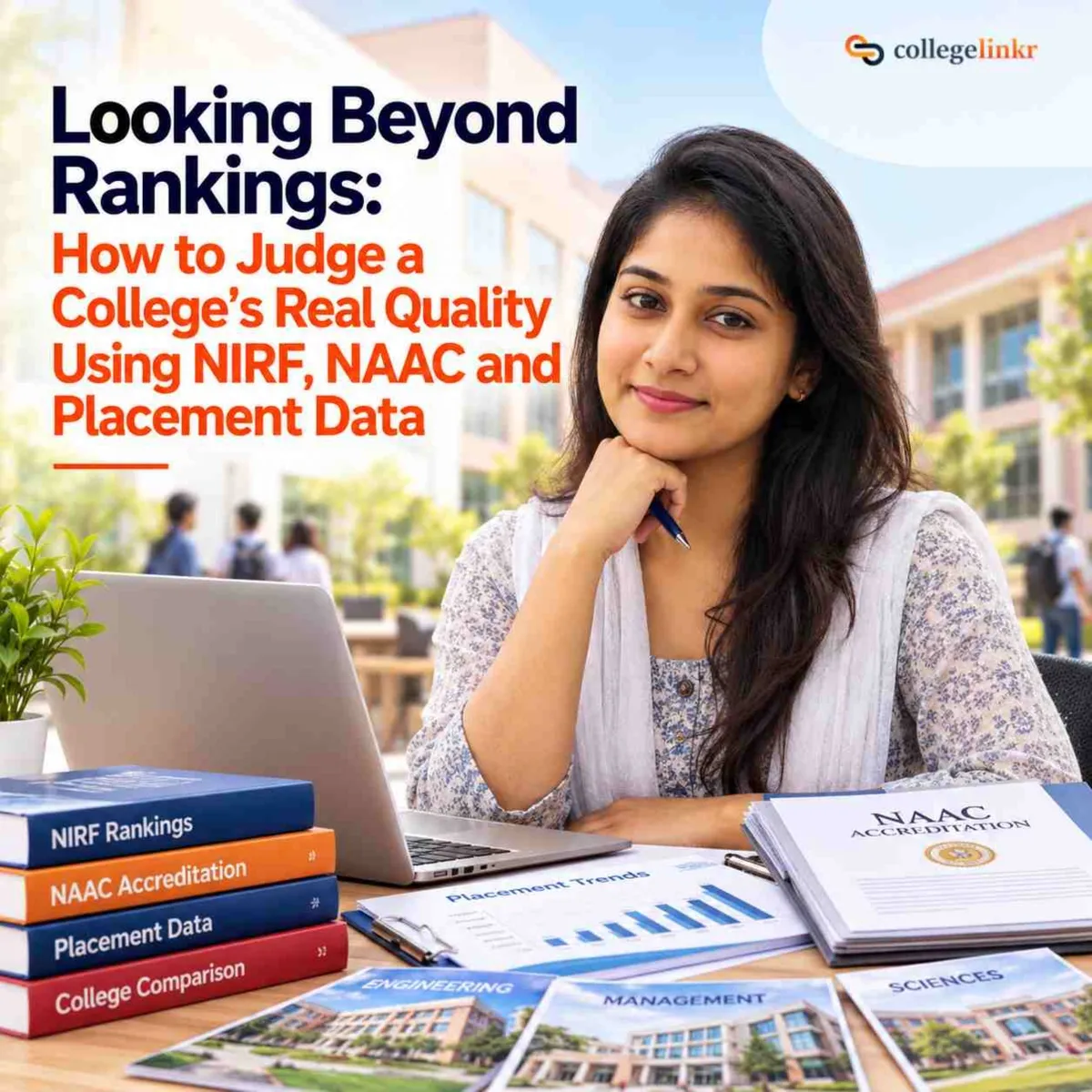
Looking Beyond Rankings: How to Judge a College's Real Quality Using NIRF, NAAC and Placement Data

Families often ask consultants one question: "Is this college good?" Rankings and grades help, but they rarely tell the full story, and most colleges are not ranked at all. This guide shows admission consultants how to read NIRF and NAAC information correctly,…
Why "Is This College Good?" Is Harder Than It Sounds
Parents want a simple answer. Students want reassurance. And consultants are expected to know which colleges are worth recommending.
The challenge is scale. The Ministry of Education's AISHE 2023-24 report covers 46,468 responding colleges, along with 1,278 universities and 11,787 standalone institutions. Only a small share of these appear in national rankings. For most colleges, a consultant has to judge quality using other evidence.
Even for ranked institutions, a rank on its own can mislead. A university ranked highly overall may have a weak department in the course a student wants. A college with a modest rank may have an outstanding programme in one field. Good guidance means looking beneath the headline number.
Step 1: Confirm the Basics Before Judging Quality
Quality only matters once recognition is confirmed. Before comparing colleges, check that:
- The college and programme have the required approvals and affiliation.
- The institution is registered on the AISHE portal, which lists universities, colleges and standalone institutions and lets anyone look up an institution's AISHE code.
- The institution does not appear on UGC's list of fake universities, and its details match what is shown on official regulator websites.
Once these checks are clear, you can look at quality.
Also Read
- Education Consultants vs an Admission Network: What Colleges Should Know Before Choosing a Partner
- From Solo Consultant to Small Agency: Scaling Your Admission Business Without Office Overheads
- Beyond Engineering and MBA: How Consultants Can Earn More From Niche, High-Demand Courses
- No Student Contacts Yet? How CollegeLinkr's Ready Leads Help Consultants Grow Beyond Their Own Circle
- Building a Trusted Consultant Brand in Your Town: Local Visibility Tactics That Bring Families to You
- Beyond Your Home State: How Admission Consultants Can Earn From Inter-State Admissions With CollegeLinkr
- Beyond B.Tech and MBA: How Offering More Courses Helps Consultants Earn More From Every Enquiry
Step 2: Read NIRF Rankings the Right Way
The National Institutional Ranking Framework, run under the Ministry of Education, ranks higher education institutions every year using five broad parameter groups: Teaching, Learning and Resources; Research and Professional Practice; Graduation Outcomes; Outreach and Inclusivity; and Perception.
Look at the right category
NIRF publishes overall rankings and separate rankings for categories and disciplines such as engineering, management, medical, pharmacy, law and others. A student choosing a management programme should look at the management ranking, not only the overall list.
Look at the parameter scores, not just the rank
Two colleges with similar ranks can be strong in very different areas. A student focused on jobs should pay close attention to graduation outcomes. A student interested in research should look at research performance.
Remember that most colleges are not ranked
Absence from NIRF does not mean a college is poor. Many good institutions, especially smaller and newer ones, do not appear. Use other evidence for them.
Check if the rank affects financial support
Under the PM-Vidyalaxmi education loan scheme, eligibility for collateral-free loans depends partly on NIRF rankings. That makes rankings relevant to families who plan to borrow.
Step 3: Understand NAAC Accreditation
The National Assessment and Accreditation Council, set up in 1994 as an autonomous body under UGC, assesses and accredits higher education institutions. Its process involves a self-study report, data verification and a peer team visit.
Check whether the institution is accredited
Accreditation shows that an institution has gone through an external quality review. Check the institution's current accreditation status and validity on NAAC's official website.
Know that frameworks change
NAAC has been updating its assessment methods. Rather than relying on older grade descriptions, check the current status and framework on NAAC's site before explaining accreditation to families.
Use accreditation as one signal, not the only one
Accreditation reflects institution-level quality processes. It does not guarantee that every programme is equally strong.
Step 4: Look at Faculty
Teachers shape a student's experience more than any building.
Faculty strength and ratio
AISHE 2023-24 reports a pupil-teacher ratio of 22 for regular mode across Indian higher education. Ask colleges about the faculty-student ratio in the specific programme you are recommending.
Qualifications and experience
Look for faculty with relevant postgraduate and doctoral qualifications and, for professional courses, industry experience.
Stability
High faculty turnover can disrupt teaching. Ask how long core faculty have been with the institution.
Step 5: Check Outcomes, Carefully
Ask for placement reports with the batch year, number of eligible students, number placed, number of recruiters and the range of salaries. Be cautious with figures that show only the highest package.
Higher studies
Many graduates go on to postgraduate study. A good college can show where its graduates continue their education.
Internships and industry exposure
For professional and technical programmes, named internship partners and industry projects are strong indicators of real-world readiness.
Step 6: Look at Infrastructure and Student Life
- Labs and equipment that match the course's practical needs
- Library resources, including digital access
- Hostel safety, food and supervision
- Anti-ragging measures and grievance systems
- Accessibility for students with disabilities
- Transport links for students coming from other cities
A short campus visit or a video call with current students can reveal more than a brochure.
Step 7: Match Quality to the Student
The best college is not the highest-ranked one. It is the one that fits the student's goals, eligibility, budget and personality.
Build a simple comparison for each shortlisted college covering recognition, NIRF and NAAC status, faculty, outcomes, infrastructure, total cost and distance from home. Discuss it openly with the family, and let the student's priorities guide the final choice.
How CollegeLinkr Helps Consultants Compare Colleges
CollegeLinkr gives Members access to more than 400 colleges across India, verified through KYC and approval checks.
- Browse course details, eligibility and fees in one place, so you can compare options quickly.
- Look beyond familiar names to find strong programmes in other cities and states.
- Share application links and track each application in real time.
- Earn service charges on confirmed admissions, with transparent payout tracking.
Starting from a verified list means your time goes into judging fit and quality, not chasing basic recognition details.
Final Thoughts
Rankings and accreditation are useful tools, but they are only the beginning of a good recommendation. The consultants families trust most are the ones who can explain why a college is right for a particular student, using faculty, outcomes, facilities and cost alongside headline numbers.
When you look beyond rankings, you give families something more valuable than a list. You give them a reasoned choice they can feel confident about.
Resources
- National Assessment and Accreditation Council (NAAC)
- AISHE Final Report 2023-24 (Department of Higher Education, Ministry of Education)
- All India Survey on Higher Education portal (Ministry of Education)
- List of fake universities (University Grants Commission)
Want to compare colleges with confidence for every student? Download the CollegeLinkr App to explore verified colleges, check course details and fees, and track each admission in one place.
Frequently Asked Questions
Grow Your Admissions With CollegeLinkr
Every seat left empty is revenue your campus never sees.
Become a partner college and fill more seats — with less effort.
Free to list · No marketing spend · Pay only on confirmed admission