
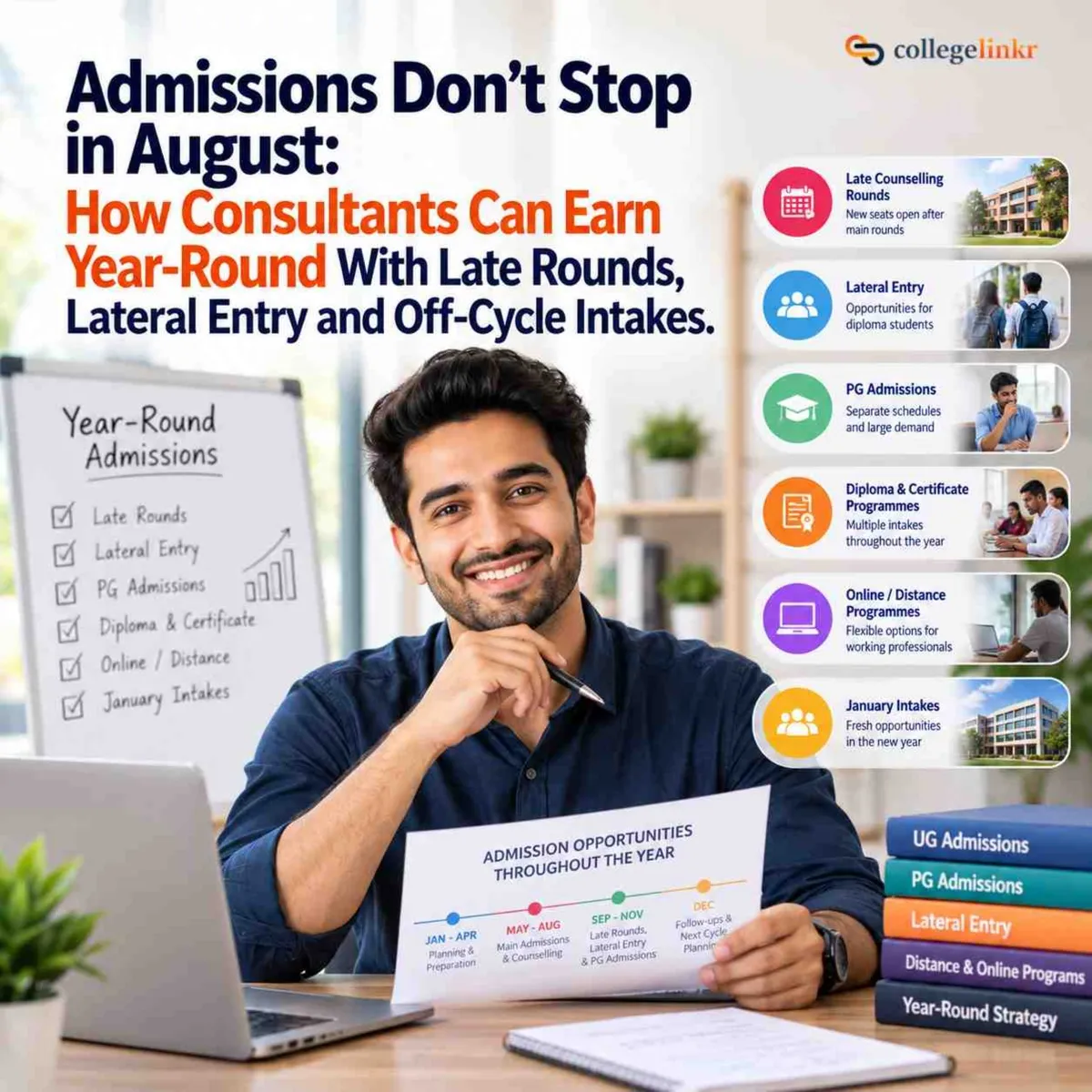
Admissions Don't Stop in August: How Consultants Can Earn Year-Round With Late Rounds, Lateral Entry and Off-Cycle Intakes

Most admission consultants work flat out from May to August and then watch their income drop for the rest of the year. But admissions in India never fully stop. Late counselling rounds, withdrawals, lateral entry, PG and diploma intakes and January sessions ke…
The Seasonal Income Trap
Talk to any admission consultant and you will hear a version of the same story. From board results until the last counselling round, the phone never stops ringing. Students, parents, college calls, document runs, late nights. Then September arrives, the rush fades and the income almost stops.
Many consultants accept this as the nature of the work. They earn most of their year's income in four months and stretch it across the other eight. Some take on side jobs. Others simply wait for the next board results.
The truth is that admissions in India are far more spread out than the peak season suggests. The students and seats are there through most of the year. What changes is where to look for them.
Where Admissions Keep Happening After the Main Season
Centralised counselling does not end with the first allotment. JoSAA, which handled seat allocation for 138 institutes in 2026, ran multiple rounds, and some institutions also used CSAB special rounds afterwards. In medical admissions, the Medical Counselling Committee runs All India Quota counselling while states run their own rounds. Every round moves students around and opens seats somewhere else.
Withdrawals and late vacancies
When students upgrade to a better allotment, release a backup seat or change plans, colleges are left with vacancies. Under the UGC fee refund policy, students who cancel within notified dates can get their fees back, so withdrawals continue well into September and October. Colleges with late vacancies need students quickly, and consultants who know where those seats are can help families who missed out earlier.
Lateral entry admissions
Diploma holders can often join the second year of degree programmes such as B.Tech through lateral entry. These admissions follow their own timelines and eligibility rules, and many diploma students have no one guiding them through the process.
Postgraduate intakes
PG admissions for MBA, MCA, M.Sc, M.Com and other programmes run on different schedules from UG admissions. According to the Ministry of Education's AISHE 2023-24 report, 12.9% of higher education enrolment is at the postgraduate level. That is a large and often under-served group of students.
Diploma and certificate programmes
The same AISHE report shows that diploma and certificate programmes make up 7.4% of total enrolment. Polytechnic diplomas, paramedical diplomas and vocational courses often have flexible or multiple admission windows.
Open, distance and online programmes
Many universities offer programmes through open and distance learning or online mode, and some follow two academic sessions a year. The UGC's Distance Education Bureau publishes lists of institutions entitled to offer these programmes. Working professionals and students who need flexibility often look for these options outside the normal admission season.
Also Read
- Beyond Your Home State: How Admission Consultants Can Earn From Inter-State Admissions With CollegeLinkr
- Know What Pays: How Tracking Your Earnings on CollegeLinkr Helps Consultants Focus on What Grows Their Business
- Zero Setup Cost, Higher Margins: How a Free CollegeLinkr Membership Lets Consultants Keep More of What They Earn?
- No MOUs, No Limits: How CollegeLinkr Helps Consultants Grow Without a College Network?
- Delayed Commissions and Payout Disputes: What Admission Consultants Should Look for in a College Partner
Building a Year-Round Admission Calendar
The simplest way to escape the seasonal trap is to map out the year. A rough calendar might look like this, although exact dates vary by state, course and institution.
January to April
- Guide Class 12 students on course choice and entrance exam planning before results arrive.
- Help students explore January-session ODL and online programmes where suitable.
- Prepare document checklists for families so they are ready when admissions open.
May to August
- Focus on core UG admissions, counselling rounds and confirmations.
- Track every student's allotment and keep backup options ready.
September to November
- Help students who missed out in main rounds find late vacancies.
- Work on lateral entry and PG admissions.
- Support families with scholarship applications, which often have deadlines in this period.
December
- Reconnect with past students and families for referrals.
- Plan outreach to schools and coaching centres for the next cycle.
Why Most Consultants Miss Off-Cycle Admissions
Late vacancies are rarely advertised widely. Without a direct line to many colleges, consultants simply do not hear about them.
Their college relationships are limited
A consultant who works with five or six colleges sees only those colleges' openings. If none of them has a vacancy, there is nothing to offer.
Lateral and PG rules feel complicated
Different eligibility rules, entrance tests and timelines can put consultants off. Yet that complexity is exactly why students need guidance.
Momentum fades after peak season
After months of intense work, it is natural to slow down. But students who missed the main rounds are often the most anxious and the most grateful for help.
How CollegeLinkr Helps Consultants Earn Through the Year
CollegeLinkr gives Members access to more than 400 verified colleges across India through one app and dashboard. That breadth is what makes year-round work possible.
- Browse colleges and courses whenever a student needs options, not just in peak season.
- See courses across UG, PG, diploma and specialised programmes from one place.
- Share application links with students and track every application in real time.
- Pick leads on the platform when your own pipeline is quiet.
- Earn service charges on confirmed admissions, with payout status visible until each payout clears.
Joining is free. You do not have to sign separate agreements with each college or wait for a college to call you about a vacancy.
Practical Tips for Steady Income
- Keep a list of students who did not get their preferred seat and check in with them after each counselling round.
- Build a separate list of diploma students who may be eligible for lateral entry.
- Stay in touch with graduates from previous years who may consider PG programmes.
- Learn the basic eligibility rules for two or three PG and lateral entry pathways in your area.
- Check open seats on the platform every week from September to November.
- Use quieter months to build relationships with schools, tutors and coaching centres.
Final Thoughts
The peak season will always be the busiest time for admission consultants. But it does not have to be the only time you earn. Late rounds, withdrawals, lateral entry, PG programmes, diplomas and off-cycle intakes together create opportunities across most of the year.
Consultants who plan for those opportunities, stay in touch with students who missed out and work with a wide network of verified colleges can turn a seasonal business into a steady one.
Resources
- Joint Seat Allocation Authority (JoSAA), Ministry of Education
- Medical Counselling Committee (MCC), Ministry of Health and Family Welfare
- AISHE Final Report 2023-24 (Department of Higher Education, Ministry of Education)
- Distance Education Bureau, University Grants Commission
Want to keep earning after peak season ends? Download the CollegeLinkr App to find verified colleges with open seats, share application links and track every admission from your phone.
Frequently Asked Questions
Grow Your Admissions With CollegeLinkr
Every seat left empty is revenue your campus never sees.
Become a partner college and fill more seats — with less effort.
Free to list · No marketing spend · Pay only on confirmed admission